CBSE Class 12 · 2024 · ElectrostaticsLong Answer

WhatsApp Email
(b)(i) A thin spherical shell of radius has a uniform surface charge density . Using Gauss's law, deduce an expression for the electric field (i) outside and (ii) inside the shell. (ii) Two long straight thin wires AB and CD have linear charge densities and respectively. They are kept parallel to each other at a distance 1 m. Find the magnitude and direction of the net electric field at a point midway between them.

Solution

(i) Concentric Gaussian sphere of radius .
Outside (), enclosed charge :

Inside (), enclosed charge is zero: .
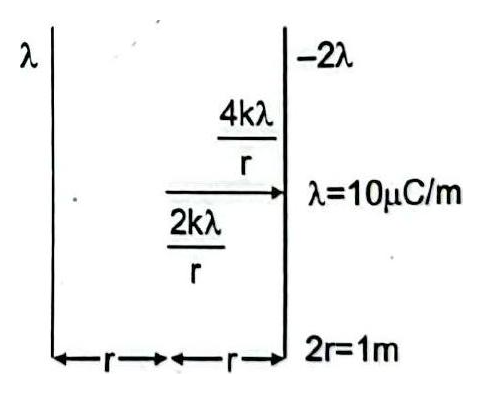
(ii) Midway, each wire is at .
Field of AB (away from AB):

Field of CD (towards CD):

Both point from AB towards CD, so they add:

CBSE Class 12 Board · 2024 · Subjective

More board questions on Electrostatics

  1. Assertion (A): Equal amounts of positive and negative charges are distributed uniformly on two halves of a thin circular ring as shown in the figure. The resultant electric field at the centre O of the ring is along OC. Reason (R): It is so because the net potential at O is not z …
    CBSE 2024View solution →
  2. Four point charges of , , and are placed at the corners A, B, C and D respectively of a square of side 30 cm. Find the net force acting on a charge of placed at the centre of the square.
    CBSE 2024View solution →
  3. Three point charges each are kept at the vertices of an equilateral triangle of side 10 cm. Find the net electric field at the centroid of the triangle.
    CBSE 2024View solution →
  4. (a)(i) Draw equipotential surfaces for an electric dipole. (ii) Two point charges and are located at and respectively in an external electric field . Obtain an expression for the potential energy of the system. (iii) The dipole moment …
    CBSE 2024View solution →
  5. The magnitude of the electric field due to a point charge object at a distance of 4.0 m is 9 N/C. From the same charged object the electric field of magnitude 16 N/C will be at a distance of
    CBSE 2023View solution →
  6. A point P lies at a distance from the midpoint of an electric dipole on its axis. The electric potential at point P is proportional to
    CBSE 2023View solution →