Most parents in Gurgaon hear "IISc" and think of it as a place for PhD students — somewhere you go after a B.Tech, if at all. That is no longer the full picture. The Indian Institute of Science, Bangalore, takes students straight after Class XII, and from the 2026-27 session it does so through two quite different doors.
This article explains both doors, who each one suits, and what the competition actually looks like.
Please note: dates, cut-offs, seat numbers and rules are set afresh every year by IISc. The figures below are from the 2026-27 cycle and are given so that you know the shape of the process. Always check iisc.ac.in and the official admission notice before acting on anything time-sensitive.
The two programmes
The four-year BS (Research). This is IISc's undergraduate science programme. The first three semesters are common, and from the fourth semester a student takes a major: Biology, Chemistry, Physics, Mathematics, or Earth and Environmental Science. (The Materials major has been discontinued from 2026-27.) The final year is largely a research project — which is the point of the degree. Most students continue to a Master's or PhD, in India or abroad.
The B.Tech programmes. IISc now runs four: Aerospace Engineering, Mechanics and Computing, Materials Science and Engineering, and Mathematics and Computing. Three of these are new from 2026-27. This is a conventional engineering degree, taught at an institution whose research depth is hard to match.
How admission works — and this is where students get confused
The two programmes do not share an admission process.
For B.Tech, everything goes through JoSAA. From 2026-27, IISc's B.Tech seats are filled through JoSAA counselling, the same counselling that allots IIT, NIT and IIIT seats, on the basis of the JEE Advanced rank. There is no separate IISc application. If your child is already in the JoSAA process, IISc simply appears as another choice to fill in the preference list.
For BS (Research), IISc runs its own admission, and accepts two different exams:
- JEE Advanced — the same exam your child is already preparing for, and
- the IISER Aptitude Test (IAT) — the entrance test for the IISERs, which IISc also accepts for this programme.
For the BS (Research) route a separate application on the IISc admission portal is compulsory, whichever exam you are using. In the 2026 cycle the portal opened on 1 May and closed on 7 June; JEE (Advanced) offers came on 12 June with in-person counselling at the Institute on 30 June, and IAT offers came on 9 July with online counselling on 16 July. Attending the counselling session is mandatory — a student who skips it loses the seat, however good the rank.
What the cut-offs look like
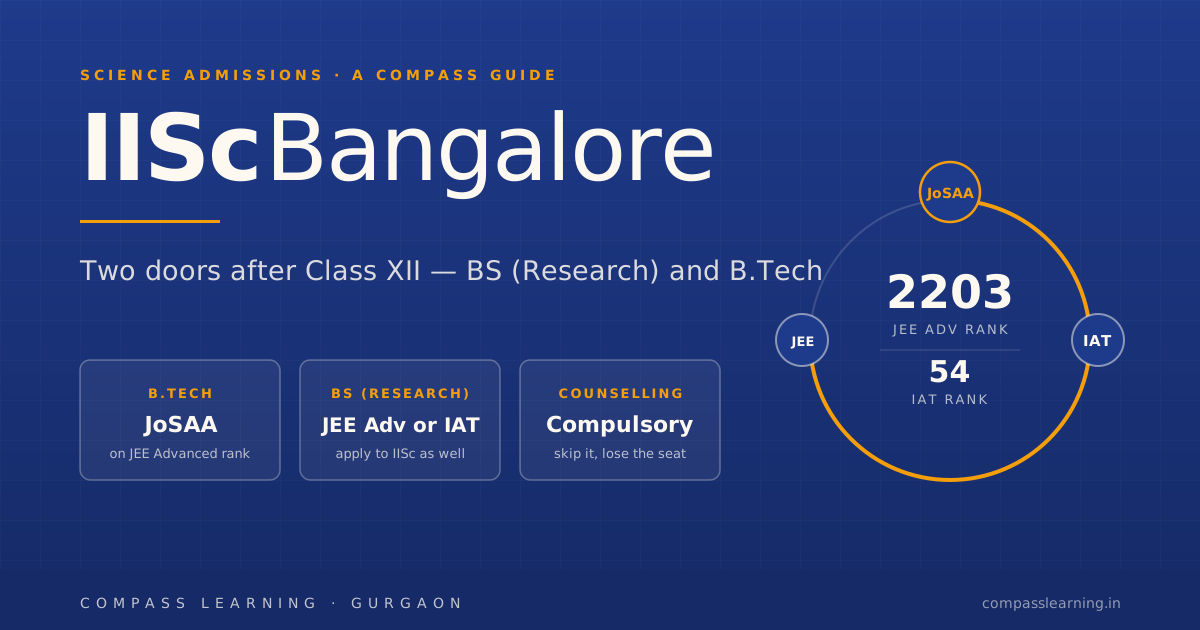
In the 2026 round, the general-category cut-off for BS (Research) was around JEE Advanced category rank 2203 in Round 1, and around IAT rank 54 in Round 2.
Those two numbers look wildly different, but they are not comparable — they come from two different exams with very different numbers of candidates. What they do tell you is that both doors are genuinely narrow, and that a student with a strong JEE Advanced rank who did not get the branch he wanted at an older IIT should look seriously at the IISc BS (Research) before settling.
Who should think about this
Be honest with yourself about the question your child is answering.
If the goal is a job in four years, the B.Tech route is the one to look at, and it competes with the IITs on exactly the same rank.
The BS (Research) suits a different student: one who enjoys the subject itself, who is curious about how things are found out rather than only how they are applied, and who is willing to study for five or six more years before a career settles. Students from this programme go on to research positions, to doctoral programmes at good universities abroad, and increasingly into data and quantitative roles in industry. It is not a shortcut, and it should not be chosen as a fallback.
What it means for preparation
The useful part: nothing exotic is required. The base is the same Class XI and XII Physics, Chemistry and Mathematics that a JEE student already studies in depth. A student preparing seriously for JEE Advanced is, by and large, already preparing for the IISc BS (Research) route as well.
If you are also planning to use the IAT door, the one change worth making is practice in that exam's own style — the questions are shorter and the paper covers Biology as well, which we have explained in our guide to the IISERs and the IAT. The NISER and NEST route is worth reading alongside it, since the three exams overlap heavily in syllabus and fall within weeks of each other.
For a student in Class XI or XII, the practical advice is simple: keep the JEE Advanced preparation at the centre, since it opens both IISc doors, and add the second exam in the final months rather than treating it as a separate project. If you would like to talk through whether this route fits your child, do get in touch — we are happy to give an honest opinion, even when the answer is that a different path suits better.


