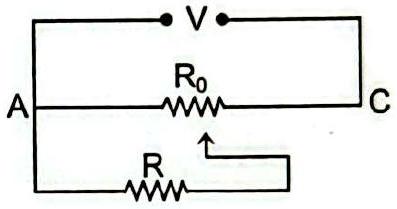
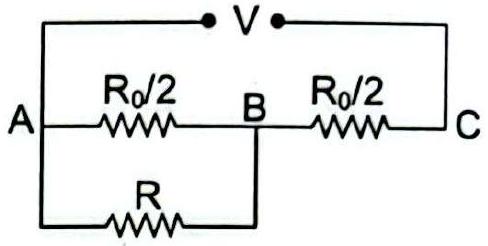
(a) Why are the connections between the resistors in a metre bridge made of thick copper strips? (b) Why is it generally preferred to obtain the balance point in the middle of the wire? (c) Which material is used for the metre-bridge wire and why? \\ \textbf{OR} \\ A resistance R draws current from a potentiometer of total resistance R0 to which a voltage V is supplied. Derive the voltage across R when the sliding contact is at the middle of the wire.
Solution
(a) Thick copper strips add essentially zero resistance, keeping the measured length truly proportional to resistance. (b) A central balance point gives comparable arm resistances, maximum sensitivity and the least effect of end errors. (c) Manganin/constantan is used — high resistivity and negligible temperature coefficient, so the wire resistance is stable. \textbf{OR:} with the slider at the middle, half the wire (R0/2) is in parallel with R while the other half carries the supply; working out the divider gives