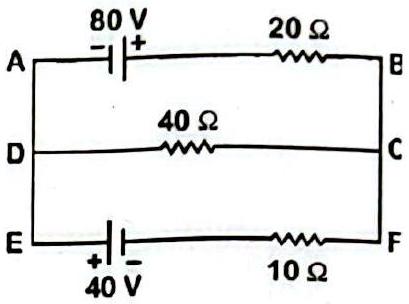
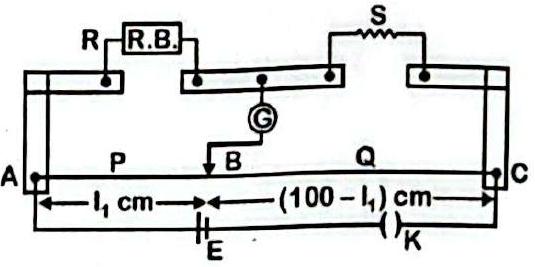
Using Kirchhoff's rules, calculate the current through the 40Ω and 20Ω resistors in the given circuit. \\ \textbf{OR} \\ What is end error in a metre bridge and how is it overcome? The two arms have R=5Ω and S. When S is shunted with an equal resistance, the new balance length is 1.5ℓ1 (with ℓ1 the initial length). Calculate S.
Answer: Current through the 20Ω resistor =4A; through the 40Ω resistor =0. [OR] S=10Ω.
Solution
Applying the loop rule to the two meshes: −10(I1+I2)+40−40I1=0⇒4−5I1=I2 and 40I1+80−20I2=0⇒2I1+4=I2. Solving, I1=0, I2=4A — so 4A flows through the 20Ω resistor and none through the 40Ω resistor. \textbf{OR:} end error is the small error from the stray resistances and the non-coincidence of the wire ends with the scale zeros; it is removed by interchanging R and S (and averaging) or by end corrections. With SR=100−ℓ1ℓ1 and S2R=100−1.5ℓ11.5ℓ1, solving gives S=2R=10Ω.