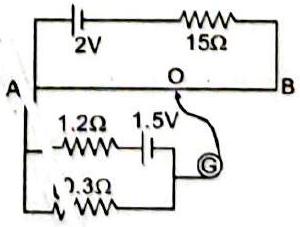
(i) Define the term drift velocity. (ii) On the basis of electron drift, derive an expression for the resistivity of a conductor in terms of the number density of free electrons and the relaxation time, and state on what factors the resistivity depends. (iii) Why are alloys like constantan and manganin used for making standard resistors? \\ \textbf{OR} \\ (i) State the principle of a potentiometer. (ii) In a potentiometer circuit AB is a uniform wire of length 1m and resistance 10Ω, driven by a 2V cell through a series 15Ω. Calculate (a) the potential gradient and (b) the balance length AO for a secondary cell of EMF whose branch current gives 0.3V across AO.
Solution
(i) \textbf{Drift velocity} is the small average velocity acquired by free electrons opposite to the applied field. (ii) With vd=meEτ and I=neAvd, Ohm's law R=IV gives R=ne2τAmℓ; comparing with R=ρAℓ, ρ=ne2τm. It depends on the material (via n and τ) and on temperature, not on the dimensions of the conductor. (iii) Because their resistivity is high and almost independent of temperature. \textbf{OR:} (i) the potential drop along a uniform current-carrying wire is proportional to its length, V=kℓ. (ii) Current in AB =15+102=0.08A, so the drop across AB =0.08×10=0.8V. (a) Gradient =100cm0.8V=8×10⁻³V cm−1. (b) AO =8×10⁻³V cm−10.3V=37.5cm.