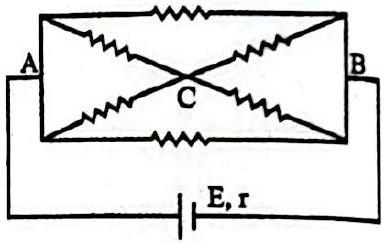
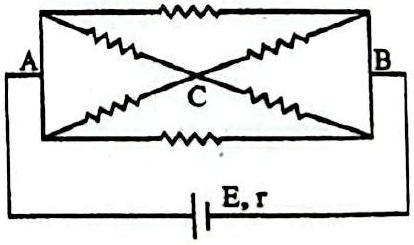
(i) Derive an expression for the drift velocity of electrons in a conductor and hence deduce Ohm's law. (ii) A wire whose cross-sectional area increases linearly from one end to the other is connected across a battery of V volts. Which of the following remains constant along the wire: drift speed, current density, electric current, electric field? \\ \textbf{OR} \\ (i) State the two Kirchhoff's laws and explain how they are justified. (ii) A current is drawn from a cell of EMF E and internal resistance r connected to a symmetric network of resistors, each of resistance r. Obtain (a) the current drawn from the cell and (b) the power consumed in the network.
Solution
(i) Under field E, a=−meE, and averaging over the relaxation time gives vd=−meEτ. Then I=neAvd=mne2AτE; writing E=V/ℓ gives I=mℓne2AτV, i.e. V=IR with R=ne2Aτmℓ constant — Ohm's law (J=σE). (ii) By continuity the same charge per second crosses every section, so the \textbf{current} is constant; since J=I/A, vd=J/ne and E=J/σ, all of these change where A changes. \textbf{OR:} (i) \emph{Junction rule} — at any node ∑I=0 (conservation of charge); \emph{loop rule} — around any closed loop ∑ΔV=0 (conservation of energy). (ii) The symmetric network reduces to Req=3r; the current from the cell is I=r+r/3E=4r3E, and the power dissipated in the network is P=I2Req=(4r3E)23r=16r3E2.