CBSE Class 12 · 2009 · Magnetic Effects of CurrentShort Answer

WhatsApp Email
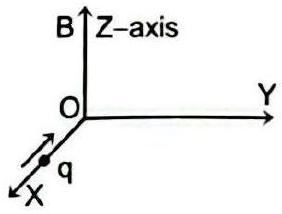
A charge moving along the X-axis with velocity is subjected to a uniform magnetic field acting along the Z-axis as it crosses the origin O. (i) Trace its trajectory. (ii) Does the charge gain kinetic energy as it enters the magnetic field? Justify your answer.

Answer: (i) A circular path in the XY-plane.
(ii) No; the kinetic energy stays constant.

Solution

(i) With along X and along Z, the force lies in the XY-plane and is always perpendicular to , so the charge moves in a circle in the XY-plane. (ii) A force perpendicular to the velocity does no work (), so the speed and hence the kinetic energy remain constant — only the direction of changes.

CBSE Class 12 Board · 2009 · Subjective

More board questions on Magnetic Effects of Current

  1. (i) State and explain Ampere's circuital law.
    (ii) Two long straight parallel wires separated by carry and current respectively in the same direction. Find the magnitude and direction of the net magnetic field at a point midway between …
    CBSE 2024View solution →
  2. Assertion (A): The energy of a charged particle moving in a magnetic field does not change.
    Reason (R): It is because the work done by the magnetic force on the charge moving in a magnetic field is zero.
    CBSE 2024View solution →
  3. Derive an expression for the magnetic force acting on a straight conductor of length carrying current in an external magnetic field . Is it valid when the conductor is in zig-zag form? Justify.
    CBSE 2024View solution →
  4. An electron moving with a velocity enters a region of uniform magnetic field . Find the radius of the circular path described by it. While rotating, does …
    CBSE 2024View solution →
  5. Beams of electrons and protons move parallel to each other in the same direction. They
    CBSE 2023View solution →
  6. A long straight wire of radius carries a steady current distributed uniformly across its cross-section. The ratio of the magnitudes of the magnetic field at and at a distance from the axis is
    CBSE 2023View solution →