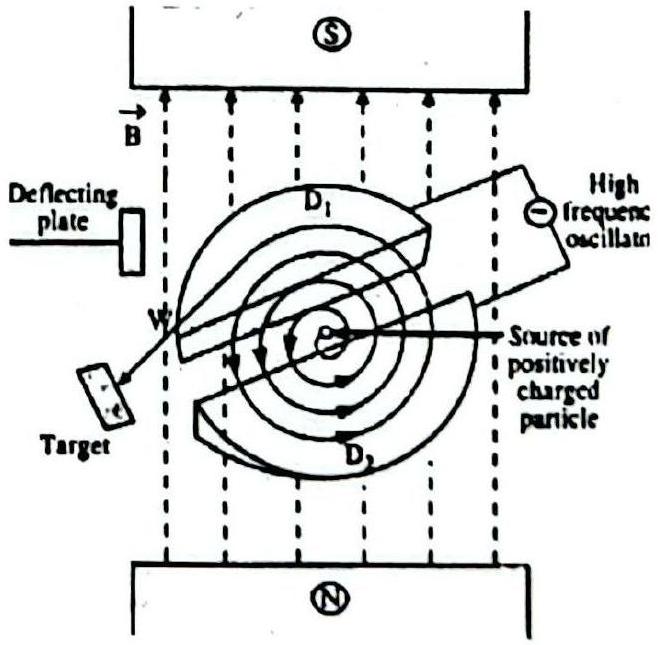
(a) Draw a schematic sketch of a cyclotron. Explain clearly the role of the crossed electric and magnetic fields in accelerating the charge. Hence derive the expression for the kinetic energy acquired by the particles. (b) An α-particle and a proton are released from the centre of the cyclotron and made to accelerate. (i) Can both be accelerated at the same cyclotron frequency? Give reason. (ii) When accelerated in turn, which will have the higher velocity at the exit slit of the dees?
Solution
(a) The \textbf{magnetic field} bends the particle into circular arcs inside the dees (doing no work); the \textbf{electric field} across the gap, reversing at the cyclotron frequency, accelerates it each crossing. At the largest radius R, v=mqBR, so
Kmax=21mv2=2mq2B2R2.
(b)(i) No — f=2πmqB depends on q/m, which differs for the α-particle and the proton, so the same frequency cannot keep both in resonance. (ii) v=mqBR∝mq; the proton has the larger q/m (1 vs 21 for the α), so the proton exits with the higher velocity.