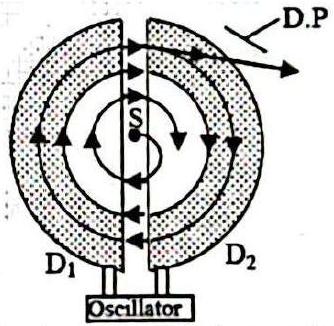
(a) Deduce an expression for the frequency of revolution of a charged particle in a magnetic field and show that it is independent of the velocity or energy of the particle. (b) Draw a schematic sketch of a cyclotron. Explain, giving the essential details of its construction, how it is used to accelerate charged particles.
Answer:f=2πmqB, independent of v.
Solution
(a) For circular motion, qvB=rmv2⇒r=qBmv. The frequency
f=2πrv=2πv⋅mvqB=2πmqB,
which contains no v — it is independent of the particle's speed or energy. (b) A cyclotron has two hollow D-shaped electrodes (dees) in a perpendicular magnetic field, with a high-frequency alternating voltage across the gap. The field curves the ion into semicircles; every gap-crossing the voltage (tuned to f) accelerates it, so it spirals outward gaining energy until it leaves at the rim.