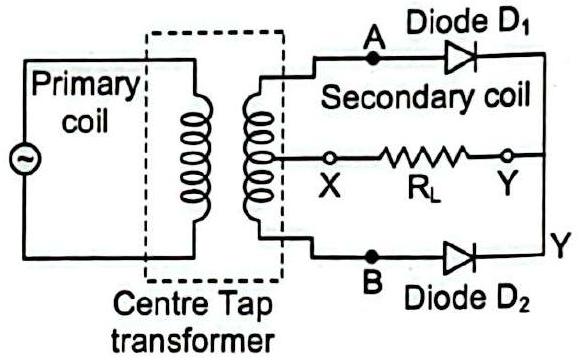
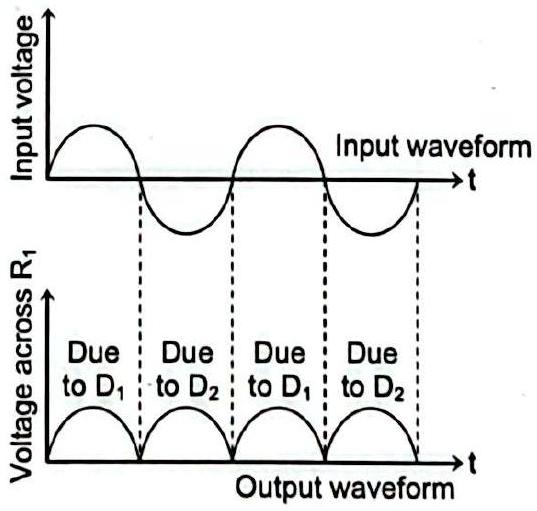
(a) Explain the characteristics of a p-n junction diode that makes it suitable for its use as a rectifier. (b) With the help of a circuit diagram, explain the working of a full wave rectifier.
Solution
(a) The key property is that the diode has very low resistance when forward biased and very high resistance when reverse biased, so it conducts in only one direction; applied to ac it passes current during the forward-biased parts only, which is the basis of rectification. (b) Full-wave rectifier: the ac is applied to a centre-tapped transformer; each secondary end feeds one diode and the load RL is between the centre tap and the common output. During the first half-cycle D1 is forward biased and conducts; during the second half-cycle D2 conducts. Both send current through RL in the same direction, so output is obtained for the full cycle (pulsating dc). Unidirectional conduction; two diodes conduct alternately.