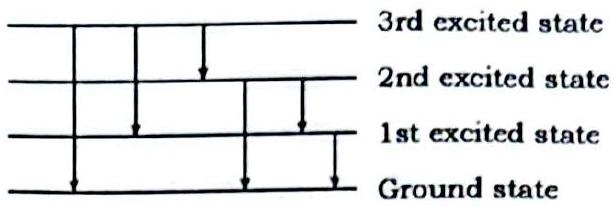
(a) Using Bohr's second postulate of quantization of orbital angular momentum, show that the circumference of the electron in the nth orbital state in a hydrogen atom is n times the de-Broglie wavelength associated with it. (b) The electron in a hydrogen atom is initially in the third excited state. What is the maximum number of spectral lines that can be emitted when it finally moves to the ground state?
Answer:2πr=nλ; maximum 6 spectral lines (from n=4).
Solution
(a) Bohr's second postulate: mvr=2πnh. The de-Broglie wavelength is λ=mvh, so mv=λh. Substituting:
λhr=2πnh⇒2πr=nλ.
Thus the circumference of the nth orbit contains exactly n de-Broglie wavelengths (a standing wave). (b) The third excited state is n=4. Maximum number of spectral lines: