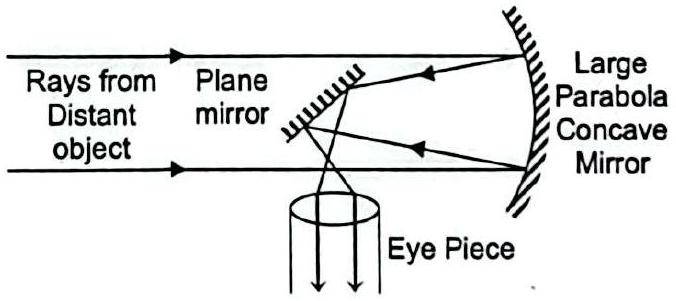
Draw a schematic ray diagram of a reflecting telescope showing how rays coming from a distant object are received at the eyepiece. Write its two important advantages over a refracting telescope.
Solution
In a reflecting (e.g. Cassegrain) telescope, parallel rays from a distant object fall on a large concave parabolic mirror, are reflected to a small secondary mirror, and are finally received at the eyepiece. \textbf{Advantages over a refracting telescope:} (i) No chromatic aberration, since reflection (unlike refraction) does not disperse light. (ii) A large-aperture mirror gives high resolving power and a bright image, and being supported along its back it does not sag like a large lens.