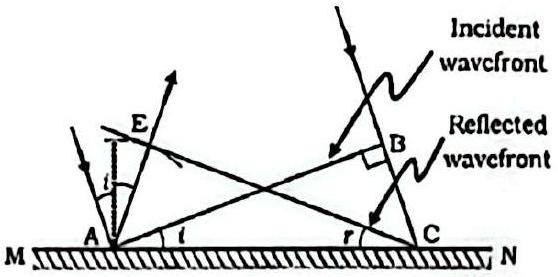
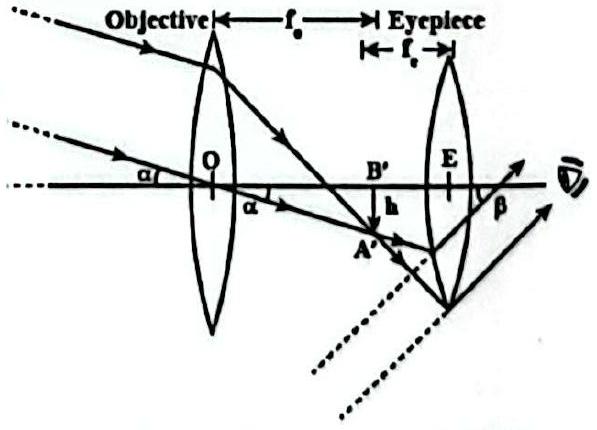
(a) (i) State Huygens' principle. With the help of a diagram, show how a plane wave is reflected from a surface and hence verify the law of reflection. (ii) A concave mirror of focal length 12cm forms a three times magnified virtual image of an object. Find the distance of the object from the mirror. (b) (i) Draw a labelled ray diagram showing the image formation by a refracting telescope. Define its magnifying power. Write two limitations of a refracting telescope over a reflecting telescope. (ii) The focal lengths of the objective and the eyepiece of a compound microscope are 1.0cm and 2.5cm respectively. Find the tube length of the microscope for obtaining a magnification of 300.
Solution
(a)(i) \textbf{Huygens' principle}: every point of a wavefront is a source of secondary wavelets that spread out with the wave speed; the forward common tangent (envelope) to these wavelets gives the new wavefront. Drawing the reflected wavelets from a plane wave shows ∠i=∠r, verifying the law of reflection. (a)(ii) Concave mirror, virtual magnified image m=+3=−uv⇒v=−3u. With f=−12cm:
v1+u1=f1⇒−3u1+u1=−121⇒3u2=−121⇒u=−8cm
(b)(i) Magnifying power m=αβ=−fefo (normal adjustment). Limitations: (1) chromatic and spherical aberration; (2) a large objective lens is heavy, sags and is hard to make. (b)(ii) Final image at infinity: m=foL⋅feD⇒300=1L×2.525=10L⇒L=30cm.