CBSE Class 12 · 2008 · Geometrical OpticsLong Answer

WhatsApp Email
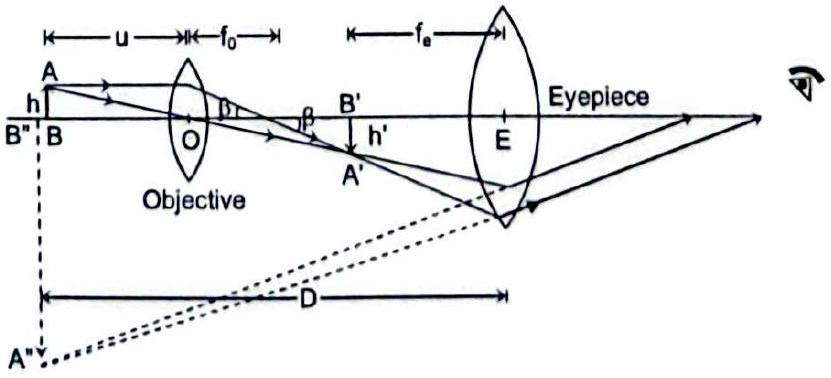
Draw a labelled ray diagram of a compound microscope and write an expression for its magnifying power. The focal lengths of the objective and eye-lens of a compound microscope are and respectively. The distance between the lenses is .
(i) How far from the objective lens will the object be kept so as to obtain the final image at the near point of the eye?
(ii) Also calculate its magnifying power.

Answer: (i) Object distance from the objective.
(ii) Magnifying power .

Solution

Magnifying power (image at near point): .
\textbf{Eyepiece:} final image at , : . So the objective's image is before the eyepiece, i.e. .
\textbf{Objective:} , : .
(i) .
(ii) .

CBSE Class 12 Board · 2008 · Subjective

More board questions on Geometrical Optics

  1. The focal lengths of the objective and the eyepiece of a compound microscope are and respectively. If the tube length of the microscope is , the magnification obtained by the microscope for most suitable viewing by a relaxed eye …
    CBSE 2024View solution →
  2. The radius of curvature of a convex mirror is . It forms an image of an object which is half the size of the object. Find the separation between the object and the image.
    CBSE 2024View solution →
  3. \textbf{Case study (prism and total internal reflection):} A ray of light suffers successive refractions on passing through the two faces of a prism; . If the angle of incidence on the second surface exceeds th …
    CBSE 2024View solution →
  4. When a ray of light of wavelength and frequency is refracted into a denser medium:
    CBSE 2024View solution →
  5. The critical angle for a ray of light passing from glass to water is minimum for:
    CBSE 2024View solution →
  6. Three beams of red, yellow and violet colours are passed through a prism, one by one, under the same condition. When the prism is in the position of minimum deviation, the angles of refraction from the second surface are and respectively. Then:
    CBSE 2024View solution →