CBSE Class 12 · 2009 · Geometrical OpticsLong Answer

WhatsApp Email
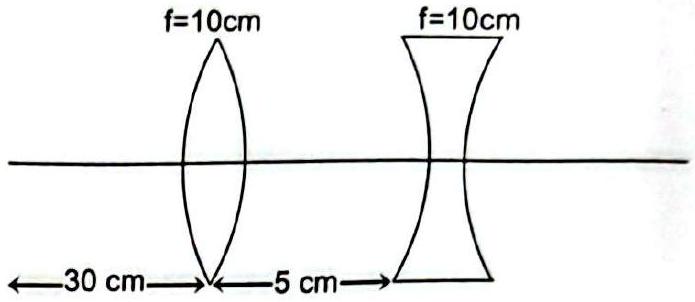
(a) (i) Draw a labelled ray diagram to show the formation of an image in an astronomical telescope for a distant object. (ii) Write three distinct advantages of a reflecting type telescope over a refracting type telescope. (b) A convex lens of focal length is placed coaxially away from a concave lens of focal length . If an object is placed in front of the convex lens, find the position of the final image formed by the combined system.

Solution

(a)(ii) Reflecting telescope advantages: (1) free from chromatic aberration; (2) large-aperture mirror high resolving power and bright image; (3) a parabolic mirror is free from spherical aberration and, supported along its back, does not sag like a large lens.
(b) \textbf{Convex lens} (, ): . This image is beyond the concave lens, a virtual object .
\textbf{Concave lens} (): .

CBSE Class 12 Board · 2009 · Subjective

More board questions on Geometrical Optics

  1. The focal lengths of the objective and the eyepiece of a compound microscope are and respectively. If the tube length of the microscope is , the magnification obtained by the microscope for most suitable viewing by a relaxed eye …
    CBSE 2024View solution →
  2. The radius of curvature of a convex mirror is . It forms an image of an object which is half the size of the object. Find the separation between the object and the image.
    CBSE 2024View solution →
  3. \textbf{Case study (prism and total internal reflection):} A ray of light suffers successive refractions on passing through the two faces of a prism; . If the angle of incidence on the second surface exceeds th …
    CBSE 2024View solution →
  4. When a ray of light of wavelength and frequency is refracted into a denser medium:
    CBSE 2024View solution →
  5. The critical angle for a ray of light passing from glass to water is minimum for:
    CBSE 2024View solution →
  6. Three beams of red, yellow and violet colours are passed through a prism, one by one, under the same condition. When the prism is in the position of minimum deviation, the angles of refraction from the second surface are and respectively. Then:
    CBSE 2024View solution →