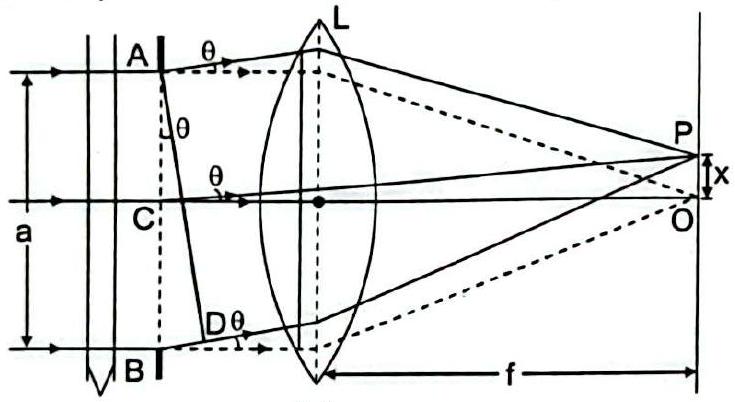
Use Huygens' principle to explain the formation of the diffraction pattern due to a single slit illuminated by a monochromatic source of light. When the width of the slit is made double the original width, how would this affect the size and intensity of the central diffraction band?
Solution
Formation of the pattern: by Huygens' principle every point of the wavefront at the slit AB (width a) acts as a source of secondary wavelets. Wavelets travelling straight (θ=0) arrive in phase at the centre O and give the bright central maximum. For a direction θ, the path difference between wavelets from the two edges is asinθ. A minimum occurs when the slit can be divided into pairs of halves that cancel:
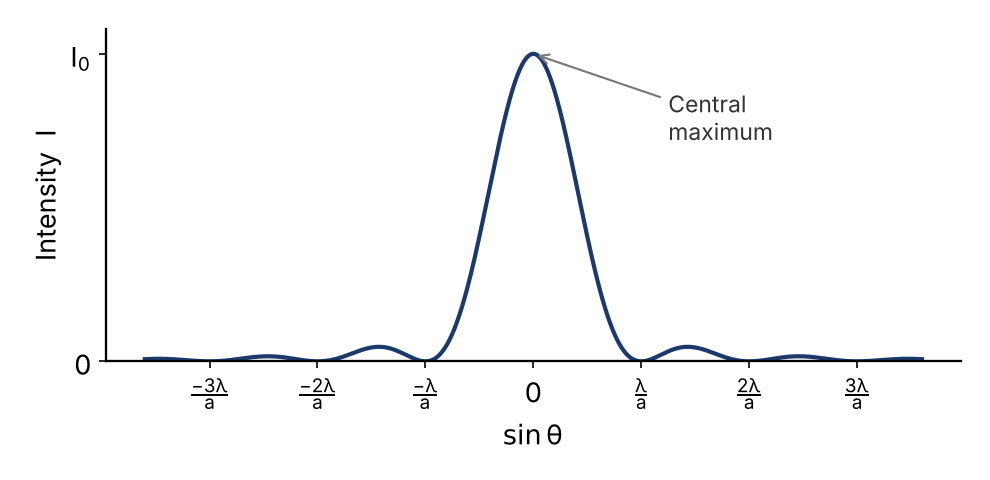
asinθ=nλ,n=1,2,3,…
and secondary maxima occur approximately at
asinθ=(2n+1)2λ
This produces a bright central band flanked by alternate dark and weak bright bands (see intensity plot). Effect of doubling the width: the angular half-width of the central band is θ≈aλ, so its linear width ∝a1. Doubling a therefore halves the width of the central band. Since twice the width of slit lets through twice the amplitude into half the area, the central intensity becomes about four times as great.