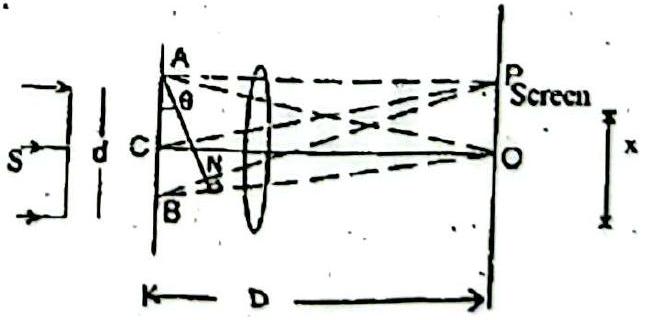
State the condition under which the phenomenon of diffraction of light takes place. Derive an expression for the width of the central maximum due to diffraction of light at a single slit. A slit of width 'a' is illuminated by monochromatic light of wavelength 700 nm at normal incidence. Calculate the value of 'a' for the position of (i) first minimum at an angle of diffraction of 30∘; (ii) first maximum at an angle of diffraction of 30∘.
Solution
Condition: diffraction becomes appreciable when the width of the slit (or obstacle) is comparable to the wavelength of light. Width of central maximum: the first minima lie at asinθ=λ, i.e. for small angles θ=aλ. If the screen is at distance D, the first minimum is at y=aλD on each side, so
Width of central maximum=2y=a2λD
Numerical (λ=700 nm, θ=30∘, sin30∘=0.5): (i) First minimum: asinθ=λ⇒a=sinθλ=0.5700=1400 nm. (ii) First (secondary) maximum: asinθ=23λ⇒a=2sinθ3λ=2×0.53×700=2100 nm.