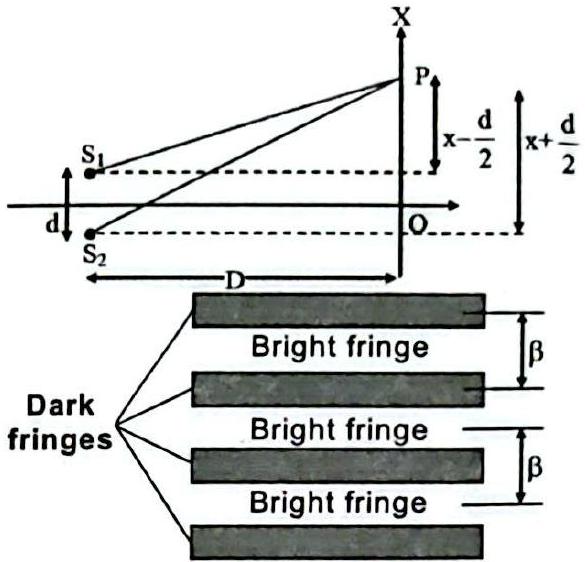
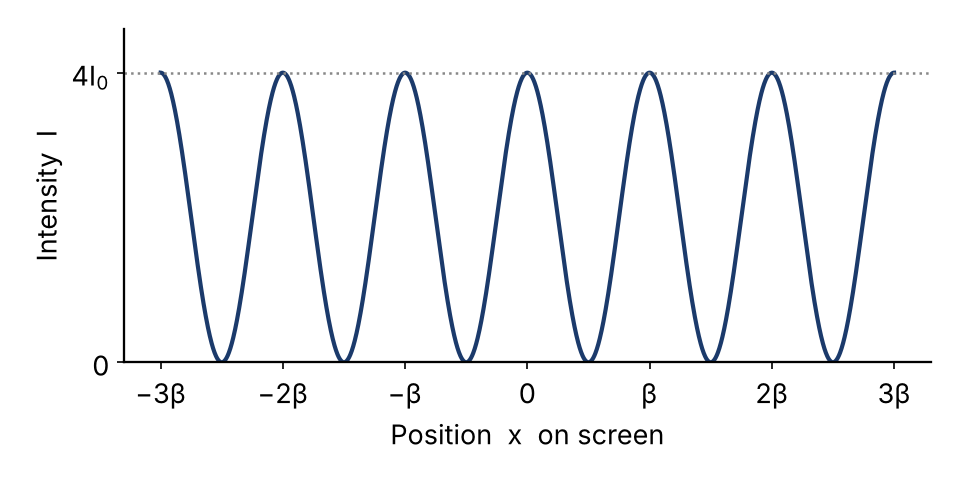
(a) In Young's double slit experiment, deduce the conditions for (i) constructive, and (ii) destructive interference at a point on the screen. Draw a graph showing the variation of intensity in the interference pattern against position 'x' on the screen. (b) Compare the interference pattern observed in Young's double slit experiment with the single slit diffraction pattern, pointing out three distinguishing features.
Solution
(a) At a point P at distance x from the centre, the path difference is Δ=Dxd. Constructive interference (bright):
Δ=nλ⇒xn=dnλD,n=0,1,2,…
Destructive interference (dark):
Δ=(2n−1)2λ⇒xn=2d(2n−1)λD
The intensity varies as I=4I0cos2λDπxd, giving equally spaced peaks of equal height (see graph). (b) Three distinguishing features: (i) Interference fringes are equally spaced and equally bright; diffraction has a broad central maximum with side bands of rapidly decreasing intensity. (ii) In interference all bright fringes have the same width; in diffraction the central band is twice as wide as the others. (iii) Interference arises from the superposition of waves from two coherent (separate) wavefronts, whereas diffraction arises from the superposition of secondary wavelets from different parts of the same wavefront.