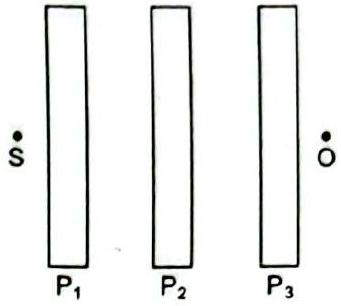
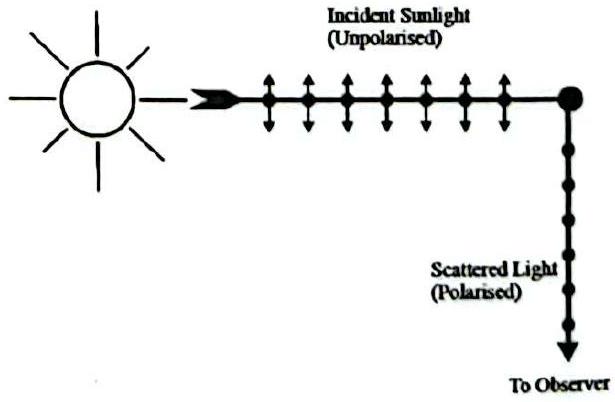
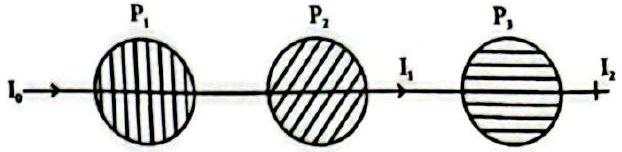
(a) Why does unpolarised light from a source not show a variation in intensity when viewed through a Polaroid which is rotated? Show with the help of a diagram how unpolarised light from the sun gets linearly polarised by scattering. (b) Three identical Polaroid sheets P1, P2 and P3 are oriented so that the pass axes of P2 and P3 are inclined at angles of 60∘ and 90∘ respectively with the pass axis of P1. A monochromatic source S of unpolarised light of intensity I0 is kept in front of the polaroid sheet P1. Determine the intensities of light as observed by the observer at O, when polaroid P3 is rotated with respect to P2 at angles θ=30∘ and 60∘.
Solution
(a) Unpolarised light contains field vibrations in all directions perpendicular to propagation, with no preferred direction. Whatever the orientation of the polaroid's pass axis, it always transmits the same average component, namely 2I0. Hence rotating the polaroid produces no change in transmitted intensity. When sunlight is scattered by air molecules, the light scattered at 90∘ to the incident beam is observed to be plane polarised: the molecular dipoles oscillating along the line of sight do not radiate towards the observer, so only the perpendicular component reaches the eye. (b) After P1: I1=2I0. P2 is at 60∘ to P1:
I2=2I0cos260∘=2I0⋅41=8I0
Now P3 is rotated to make angle θ with P2. For θ=30∘:I3=8I0cos230∘=8I0⋅43=323I0. For θ=60∘: this makes P3 perpendicular to P2 (60∘+..., net 90∘ from P2), so
I3=8I0cos290∘=0
I(30∘)=323I0,I(60∘)=0
CBSE Class 12 Board · 2016 · All India · Subjective