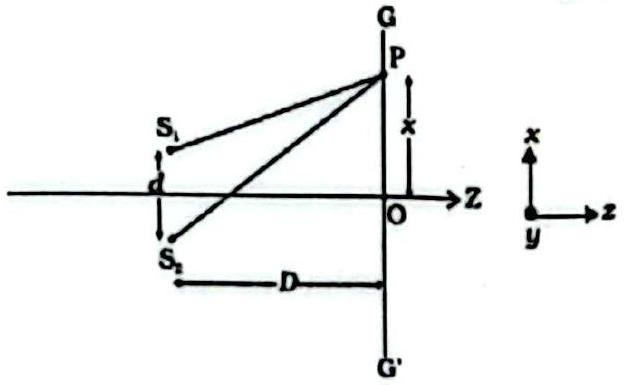
(a) In Young's double slit experiment, a monochromatic source of light S is kept equidistant from the slits S1 and S2. Explain the formation of dark and bright fringes on the screen. (b) A beam of light consisting of two wavelengths, 650 nm and 520 nm, is used to obtain interference fringes in a Young's double-slit experiment. (i) Find the distance of the third bright fringe on the screen from the central maximum for wavelength 650 nm. (ii) What is the least distance from the central maximum where the bright fringes due to both the wavelengths coincide? Given: the separation between the slits is 4 mm and the distance between the screen and the plane of the slits is 1.2 m.
Answer: (i) x=0.585 mm. (ii) x=0.78 mm (where the 4th fringe of 650 nm meets the 5th of 520 nm).
Solution
(a) Since S is equidistant from S1 and S2, the two slits act as coherent sources in phase. At the central point O the path difference is zero, giving a bright fringe. At a general point the path difference is Δ=Dxd; where Δ=nλ the waves arrive in phase (bright fringe), and where Δ=(2n−1)2λ they arrive out of phase (dark fringe). This produces alternate bright and dark fringes. (b)(i) Third bright fringe for λ1=650 nm (d=4×10⁻³ m, D=1.2 m):