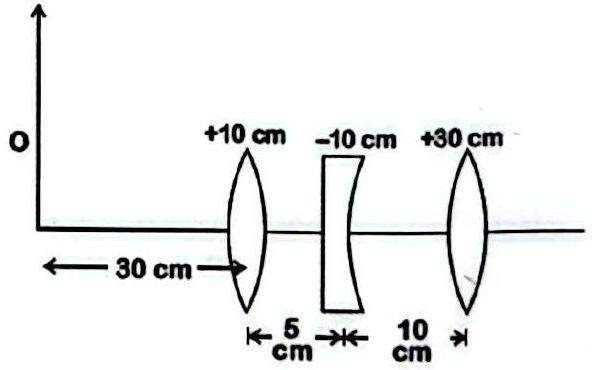
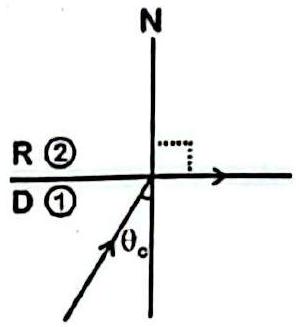
(a) Under what conditions is the phenomenon of total internal reflection of light observed? Obtain the relation between the critical angle of incidence and the refractive index of the medium. (b) Three lenses of focal lengths +10 cm, −10 cm and +30 cm are arranged coaxially as shown in the figure. An object is placed 30 cm in front of the first lens, and the separations are 5 cm (between the first and second) and 10 cm (between the second and third). Find the position of the final image formed by the combination.
Solution
(a) Conditions for total internal reflection: (i) light must travel from an optically denser to an optically rarer medium; (ii) the angle of incidence must exceed the critical angle θc. At the critical angle the refracted ray grazes the surface (r=90∘). Applying Snell's law at the denser-to-rarer interface,
μsinθc=1⋅sin90∘⇒sinθc=μ1
(b) Lens 1 (f1=+10 cm, u=−30 cm):
v1−−301=101⇒v1=101−301=151⇒v=+15cm
This image is 15 cm right of lens 1, i.e. 10 cm right of lens 2, so it is a virtual object for lens 2: u=+10 cm. Lens 2 (f2=−10 cm):
v1−101=−101⇒v1=0⇒v=∞
so the rays leave lens 2 parallel to the axis. Lens 3 (f3=+30 cm, object at infinity):
v1−0=301⇒v=+30cm
Final image is 30cm to the right of the third (+30 cm) lens.