CBSE Class 12 · 2010 · Linear ProgrammingLong Answer

WhatsApp Email
A small firm manufactures gold rings and chains. The total number of rings and chains manufactured per day is at most 24. It takes 1 hour to make a ring and 30 minutes to make a chain. The maximum number of hours available per day is 16. If the profit on a ring is Rs. 300 and that on a chain is Rs. 190, find the number of rings and chains that should be manufactured per day so as to earn the maximum profit. Make it as an L.P.P. and solve it graphically.

Answer: Max profit = Rs 5440 at (8, 16): 8 rings and 16 chains

Solution

Let gold rings and chains be made per day.
Profit: .
Total number:
Time:

Corner points: , , (intersection of and ) and .
Evaluate :
:
: ← maximum
:

8 gold rings and 16 chains should be manufactured per day.
Structure Feasible region for x + y = 24 and x + y/2 = 16, with corner points (0, 24), (8, 16) and (16, 0).
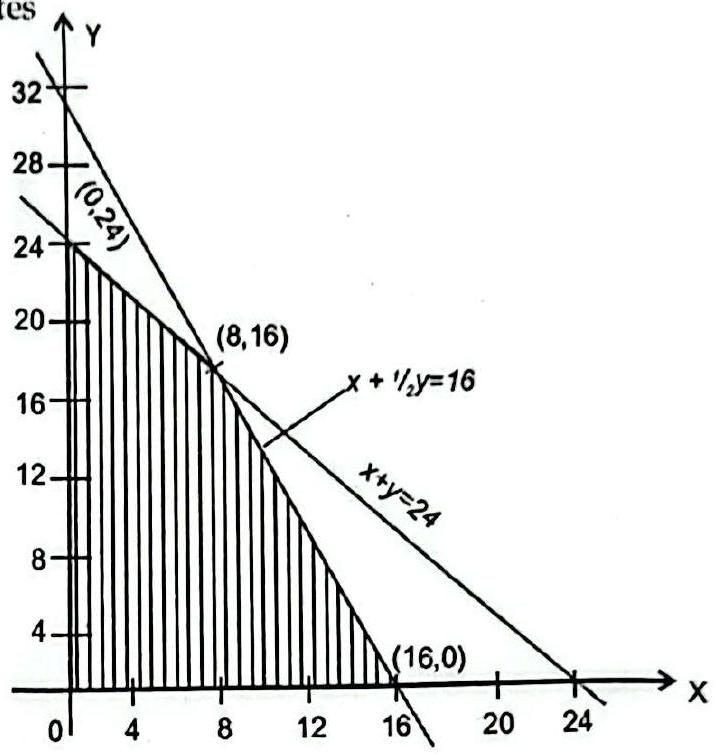
Feasible region for x + y = 24 and x + y/2 = 16, with corner points (0, 24), (8, 16) and (16, 0).

CBSE Class 12 Board · 2010 · Subjective

More board questions on Linear Programming

  1. Solve the following Linear Programming problem graphically:
    Maximize
    subject to


    CBSE 2024View solution →
  2. The objective function of an LPP has maximum value 42 at and minimum value 19 at . Which of the following is true?
    CBSE 2023View solution →
  3. The corner points of the feasible region of a linear programming problem are , and . If is the objective function, then (maximum value of minimum value of ) is equal to:
    CBSE 2023View solution →
  4. Solve the following linear programming problem graphically:
    Maximize
    subject to the constraints


    CBSE 2023View solution →
  5. The corner points of the feasible region determined by the system of linear inequalities are , , and . If the maximum value of , where , occurs at both and , then:
    CBSE 2020View solution →
  6. A furniture trader deals in only two items — chairs and tables. He has Rs. 50,000 to invest and a space to store at most 35 items. A chair costs him Rs. 1000 and a table costs him Rs. 2000. The trader earns a profit of Rs. 150 and Rs. 250 on a chair and a table, respectively. For …
    CBSE 2020View solution →