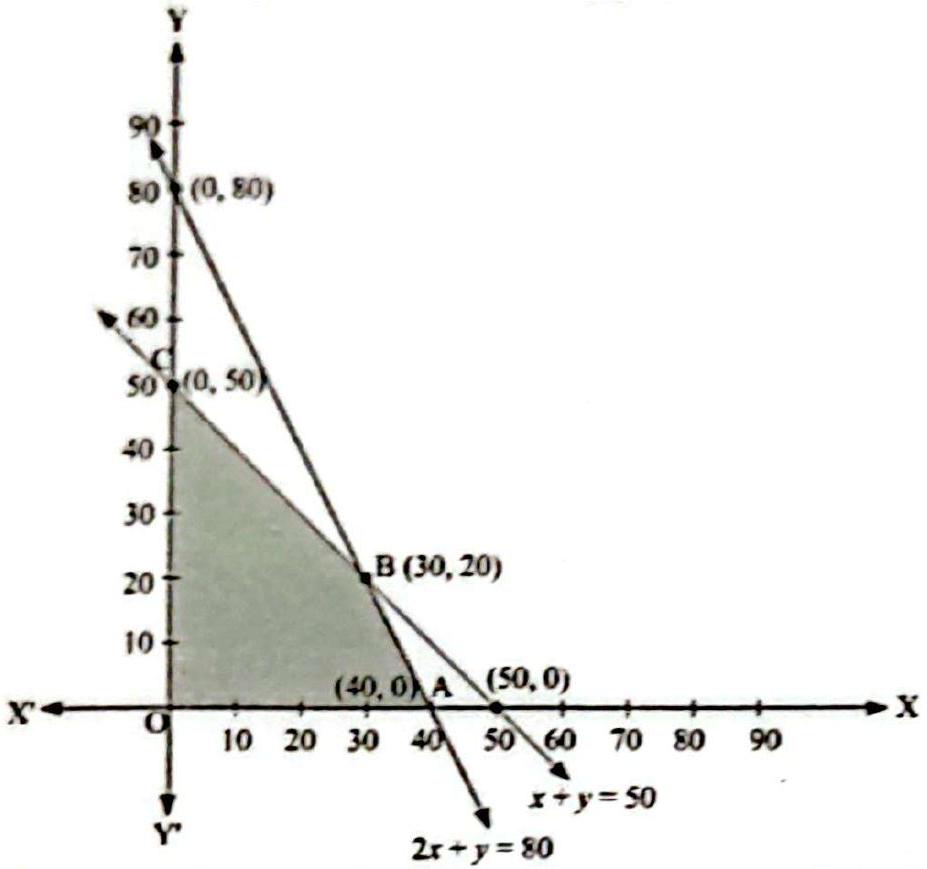
A cooperative society of farmers has 50 hectares of land to grow two crops A and B. The profits from crops A and B per hectare are estimated at Rs. 10,500 and Rs. 9,000 respectively. To control weeds, a liquid herbicide has to be used for crops A and B at the rate of 20 litres and 10 litres per hectare, respectively. Further, not more than 800 litres of herbicide should be used in order to protect fish and wildlife using a pond which collects drainage from this land. Keeping in mind that the protection of fish and other wildlife is more important than earning profit, how much land should be allocated to each crop so as to maximize the total profit? Form an LPP from the above and solve it graphically. Do you agree with the message that the protection of wildlife is utmost necessary to preserve the balance in the environment?
Answer: Max profit = Rs 4,95,000 at (30, 20): 30 ha for crop A and 20 ha for crop B
Solution
Let x hectares be allocated to crop A and y hectares to crop B. Profit: Z=10500x+9000y. Land: x+y≤50 Herbicide: 20x+10y≤800⟹2x+y≤80 x≥0,y≥0 Corner points: (0,0), (40,0), (30,20) (intersection of x+y=50 and 2x+y=80) and (0,50). Evaluate Z=10500x+9000y: (0,0): Z=0 (40,0): Z=420000 (30,20): Z=315000+180000=495000 ← maximum (0,50): Z=450000
∴Zmax=Rs 4,95,000 at (30,20)
30 hectares should be allocated to crop A and 20 hectares to crop B. Yes, protecting wildlife is essential to preserve the ecological balance of the environment.Feasible region for x + y = 50 and 2x + y = 80, with corner points O(0, 0), A(40, 0), B(30, 20) and C(0, 50).