A factory manufactures two types of screws, A and B, each type requiring the use of two machines, an automatic and a hand-operated. It takes 4 minutes on the automatic and 6 minutes on the hand-operated machine to manufacture a packet of screws 'A', while it takes 6 minutes on the automatic and 3 minutes on the hand-operated machine to manufacture a packet of screws 'B'. Each machine is available for at most 4 hours on any day. The manufacturer can sell a packet of screws 'A' at a profit of 70 paise and screws 'B' at a profit of Rs. 1. Assuming that he can sell all the screws he manufactures, how many packets of each type should the factory owner produce in a day in order to maximize his profit? Formulate the above LPP and solve it graphically and find the maximum profit.
Answer: Max profit = Rs 41 at (30, 20): 30 packets of A and 20 packets of B
Solution
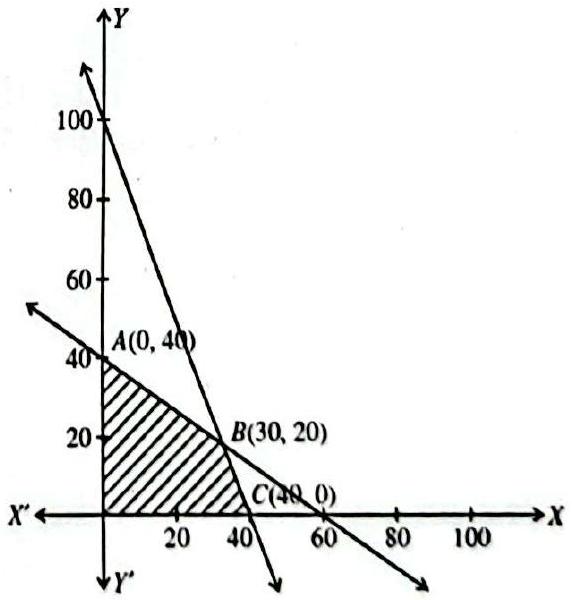
Let x packets of screw A and y packets of screw B be produced per day. Profit: Z=0.70x+y. Automatic machine (240 min): 4x+6y≤240⟹2x+3y≤120 Hand-operated machine (240 min): 6x+3y≤240⟹2x+y≤80 x≥0,y≥0 Corner points: (0,0), (40,0), (30,20) (intersection of 2x+3y=120 and 2x+y=80) and (0,40). Evaluate Z=0.70x+y: (40,0): Z=28 (30,20): Z=21+20=41 ← maximum (0,40): Z=40
∴Zmax=Rs 41 at (30,20)
The factory should produce 30 packets of screw A and 20 packets of screw B for a maximum profit of Rs 41.Feasible region for 2x + 3y = 120 and 2x + y = 80, with corner points O(0, 0), A(0, 40), B(30, 20) and C(40, 0).