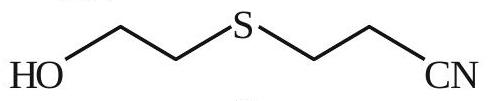
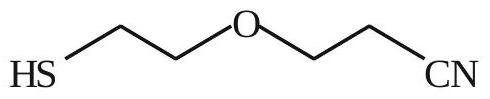
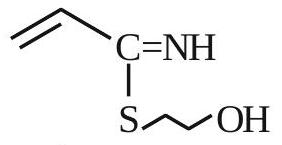
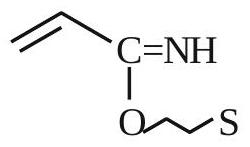
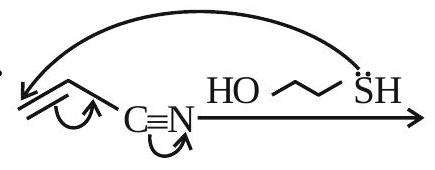
The two reagents are acrylonitrile, \ce{CH2=CH-CN}, and 2-mercaptoethanol, \ce{HO-CH2CH2-SH}. The electron-poor double bond of acrylonitrile is a Michael acceptor, and the thiol sulfur, being soft and highly polarisable, is a far better nucleophile than the hydroxyl oxygen. The sulfur therefore adds in a conjugate (thia-Michael) fashion to the terminal carbon of the alkene while the hydroxyl group is left untouched, joining the two fragments through a sulfide bridge. The major product is \ce{HOCH2CH2-S-CH2CH2-CN}, 3-(2-hydroxyethylsulfanyl)propanenitrile.Mechanism
JEE Main · 2023 · 13 Apr 2023 · Shift 2 · Single correct option