Let a be a non-zero vector parallel to the line of intersection of the two planes described by i^+j^,i^+k^ and i^−j^,j^−k^. If θ is the angle between the vector a and the vector b=2i^−2j^+k^ and a⋅b=6 then the ordered pair (θ,∣a×b∣) is equal to
(A)(4π,36)
(B)(3π,36)
(C)(3π,6)
(D)(4π,6)✓ Correct
Answer: (D)
Solution
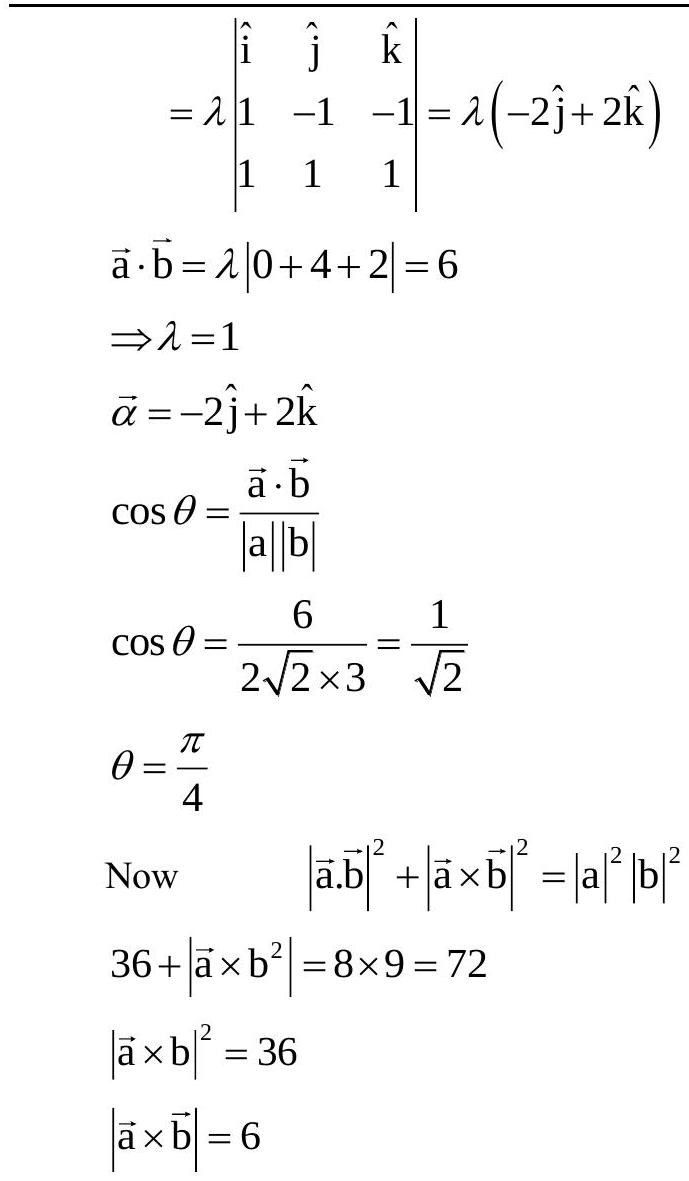
Each plane contains the two given vectors, so its normal is their cross product: n1=(i^+j^)×(i^+k^)=i^−j^−k^ and n2=(i^−j^)×(j^−k^)=i^+j^+k^. The line of intersection is parallel to n1×n2=−2j^+2k^, so a=λ(j^−k^). From a⋅b=6 with b=2i^−2j^+k^, −3λ=6, giving λ=−2 and a=−2j^+2k^. Then ∣a∣=22 and ∣b∣=3, so cosθ=∣a∣∣b∣a⋅b=22⋅36=21, which gives θ=4π. Also ∣a×b∣=∣a∣∣b∣sinθ=22⋅3⋅21=6. The required ordered pair is (4π,6).
JEE Main · 2023 · 11 Apr 2023 · Shift 1 · Single correct option