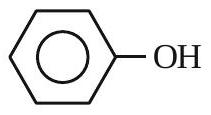
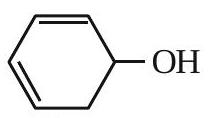
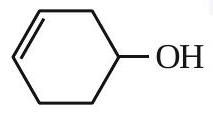
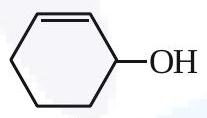
Decreasing order of dehydration of the following alcohols is a (see structure) b (see structure) c (see structure) d (see structure)abcd
(A)a>d>b>c
(B)b > d > c > a✓ Correct
(C)b>a>d>c
(D)d>b>c>a
Answer: (B)
Solution
The ease of acid-catalysed dehydration follows the stability of the carbocation and of the alkene produced. Alcohol b is cyclohexa-2,4-dien-1-ol, and loss of water from it yields benzene, so the large aromatic stabilisation makes it dehydrate most readily. Alcohol d, cyclohex-2-en-1-ol, is allylic, so its carbocation is resonance stabilised and it reacts next most easily to give a conjugated diene. Alcohol c, cyclohex-3-en-1-ol, is only homoallylic and its double bond cannot stabilise the developing cation directly, so it reacts less readily. Phenol, a, carries its hydroxyl on an aromatic carbon and does not undergo this dehydration at all. The decreasing order of dehydration is therefore b, then d, then c, then a.
JEE Main · 2023 · 01 Feb 2023 · Shift 1 · Single correct option