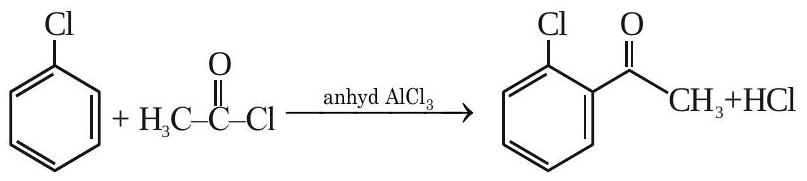
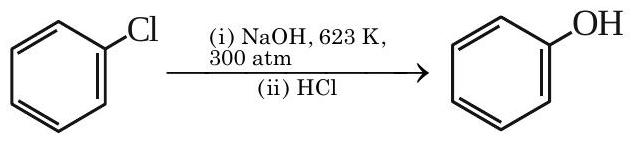
Aqueous potassium hydroxide favours nucleophilic substitution, so 1-bromopropane with KOH(aq) correctly gives propan-1-ol. Friedel-Crafts acylation of chlorobenzene with acetyl chloride and anhydrous AlCl3 correctly gives chloroacetophenone, and chlorobenzene heated with sodium hydroxide at 623K and 300atm followed by acidification correctly gives phenol by the Dow process. The remaining change, neopentyl bromide with alcoholic KOH written to yield neopentyl alcohol, is wrong, because alcoholic KOH promotes elimination rather than substitution and the neopentyl framework in any case has no β-hydrogen and resists clean substitution. The incorrectly represented conversion is the neopentyl bromide reaction.
JEE Main · 2023 · 01 Feb 2023 · Shift 1 · Single correct option