The one giving maximum number of isomeric alkenes on dehydrohalogenation reaction is (excluding rearrangement)
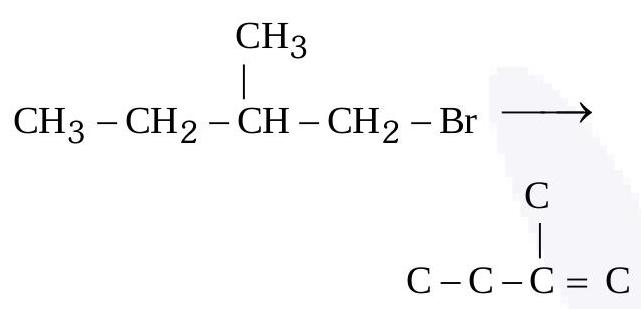
(A)1-Bromo-2-methylbutane
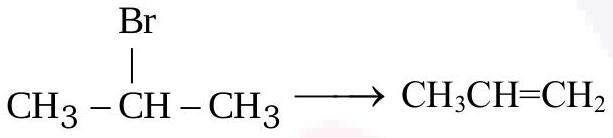
(B)2-Bromopropane
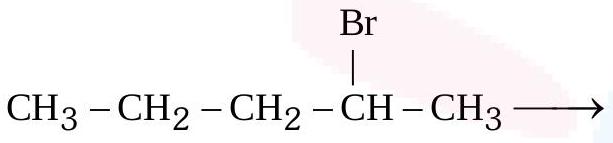
(C)2-Bromopentane✓ Correct
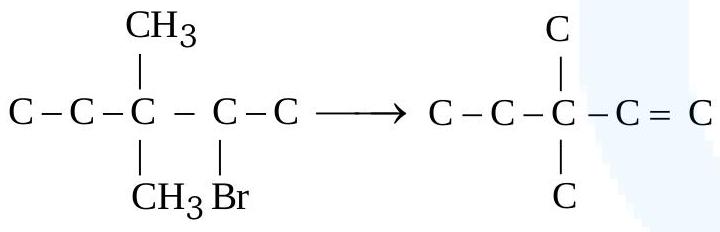
(D)2-Bromo-3,3-dimethylpentane
Answer: (C)
Solution
Dehydrohalogenation removes the halogen together with a hydrogen from a carbon next to the one bearing it, so the number of distinct alkenes depends on how many different hydrogen-bearing neighbours there are and on whether geometrical isomerism is possible. In 1-bromo-2-methylbutane only one neighbouring carbon carries hydrogen, giving a single alkene. In 2-bromopropane the two neighbouring carbons are equivalent, so again only one alkene, propene, forms. In 2-bromo-3,3-dimethylpentane one neighbour is a quaternary carbon with no hydrogen, leaving only one alkene. In 2-bromopentane the halogen-bearing carbon has two different hydrogen-bearing neighbours: elimination towards the end of the chain gives pent-1-ene, while elimination into the chain gives pent-2-ene, which itself exists as cis and trans forms. This produces three isomeric alkenes, the largest number among the given halides, so the maximum is given by 2-bromopentane.
JEE Main · 2023 · 29 Jan 2023 · Shift 2 · Single correct option