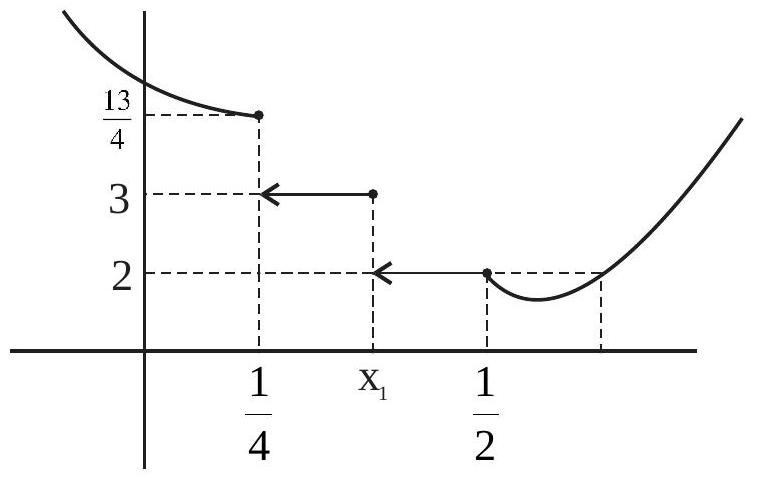
Let f(x)={4x2−8x+5, if 8x2−6x+1≥0[4x2−8x+5], if 8x2−6x+1<0, where [α] denotes the greatest integer less than or equal to α. Then the number of points in R where f is not differentiable is ______.
Answer: 3
Solution
First, solve 8x2−6x+1≥0. The roots are x=41 and x=21. So the condition holds for x≤41 or x≥21.
For x∈[41,21], we use the greatest integer function [4x2−8x+5]. The expression 4x2−8x+5=4(x−1)2+1 has minimum value 1 at x=1. In the interval [41,21], evaluate: at x=41: value is 1; at x=21: value is 2. The function 4x2−8x+5 is continuous and takes values in [1,2) on this interval.
For x∈/[41,21], we use ∣4x2−8x+5∣. The expression 4x2−8x+5 has roots where it equals zero, but checking the discriminant: 64−80<0, so it's always positive, meaning the absolute value has no effect.
Non-differentiability occurs at:
x=41 (transition point)
x=21 (transition point)
One point inside [41,21] where the greatest integer function jumps (where 4x2−8x+5 crosses an integer).