The number of non-ionisable protons present in the product B obtained from the following reaction is ____. CX2HX5OH+PClX3CX2HX5Cl+A A+PClX3B
Answer: 2
Solution
First reaction: Ethanol reacts with PClX3 to give ethyl chloride and phosphorous acid: CX2HX5OH+PClX3CX2HX5Cl+HX3POX3 (A = HX3POX3)
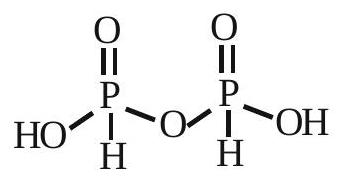
Second reaction: Phosphorous acid reacts with PClX3 to form pyrophosphorous acid: HX3POX3+PClX3HX4PX2OX5+HCl (B = HX4PX2OX5)
In pyrophosphorous acid (HX4PX2OX5), the structure shows two phosphorus atoms bridged by oxygen, with each P having one P-H bond and P-OH groups. The two P-H protons are non-ionisable (directly bonded to phosphorus), while the two O-H protons are ionisable. Therefore, the number of non-ionisable protons = 2.