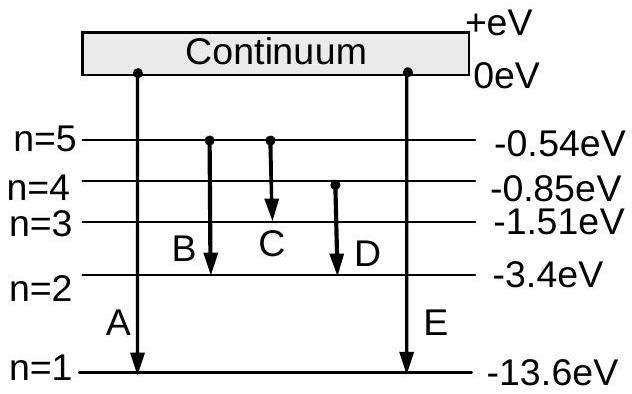
In the given figure, the energy levels of hydrogen atom have been shown along with some transitions marked A, B, C, D and E. The transitions A, B and C respectively represent:
(A)The series limit of Lyman series, second member of Balmer series and second member of Paschen series.
(B)The first member of the Lyman series, third member of Balmer series and second member of Paschen series.
(C)The ionization potential of hydrogen, second member of Balmer series and third member of Paschen series.
(D)The series limit of Lyman series, third member of Balmer series and second member of Paschen series.✓ Correct
Answer: (D)
Solution
From the energy level diagram:
Transition A: From n=∞ to n=1 represents ionization (or series limit of Lyman series, which is ionization from ground state).
Transition B: From n=4 to n=2 is the second member of the Balmer series (first member is n=3→2, second is n=4→2).
Transition C: From n=6 to n=3 is the third member of the Paschen series (first member is n=4→3, second is n=5→3, third is n=6→3).
The answer is (C): The ionization potential of hydrogen, second member of Balmer series and third member of Paschen series.
JEE Main · 2021 · 24 Feb 2021 · Shift 1 · Single correct option