JEE Main · 2021 · 24 Feb 2021 · Shift 1 · Electrostatics

WhatsApp Email
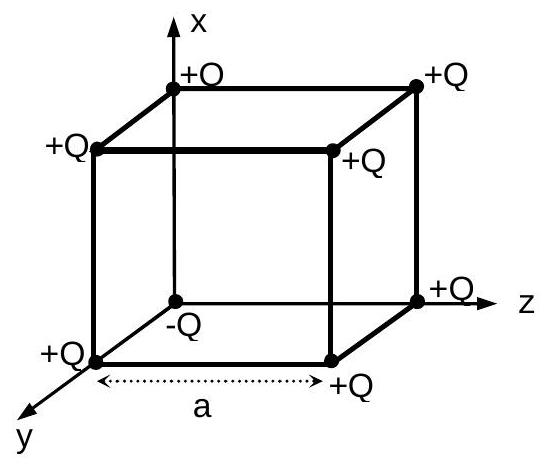
A cube of side '' has point charges located at each of its vertices except at the origin where the charge is -Q. The electric field at the centre of cube is:
  1. (A)
  2. (B)
  3. (C)✓ Correct
  4. (D)

Answer: (C)

Solution

If all eight vertices had charge , the electric field at the center would be zero by symmetry.

The actual configuration is equivalent to having charge at the origin (since we have instead of ).

The distance from origin to center is . The electric field is:

JEE Main · 2021 · 24 Feb 2021 · Shift 1 · Single correct option

More JEE Main questions on Electrostatics

  1. Six point charges are kept 60° apart from each other on the circumference of a circle of radius R as shown in figure. The net electric field at the centre of the circle is ______.
    ( is permittivity of free space)
    JEE Main 2026View solution →
  2. Electric field in a region is given by , where and . If the electric potential at a point is 500 V , then the electric potential at origin is ____ V.
    JEE Main 2026View solution →
  3. Three small identical bubbles of water having same charge on each coalesce to form a bigger bubble. Then the ratio of the potentials on one initial bubble and that on the resultant bigger bubble is :
    JEE Main 2026View solution →
  4. Five positive charges each having charge are placed at the vertices of a pentagon as shown in the figure. The electric potential () and the electric field () at the center O of the pentagon due to these five positive charges are:
    JEE Main 2026View solution →
  5. Two point charges 2q and q are placed at vertex A and centre of face CDEF of the cube as shown in figure. The electric flux passing through the cube is :
    JEE Main 2026View solution →
  6. Two shorts dipoles , A having charges and length 1 cm and having charges and length 1 cm are placed with their centres 80 cm apart as shown in the figure. The electric field at a point , equi-distant from the …
    JEE Main 2026View solution →