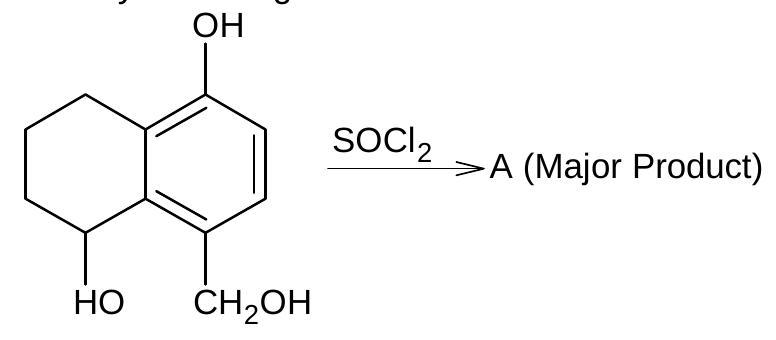
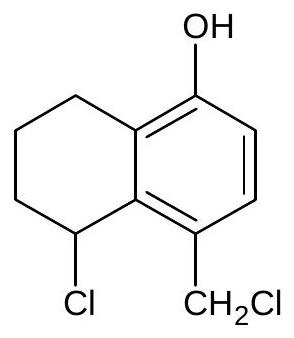
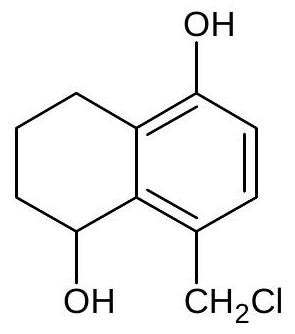
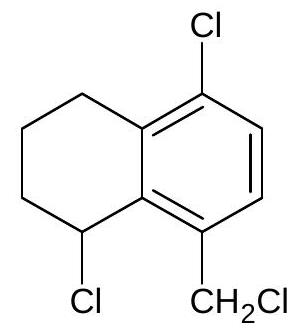
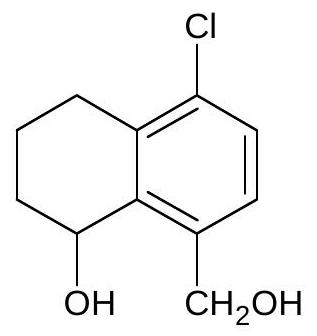
Thionyl chloride replaces the hydroxyl group of an alcohol by chlorine through a chlorosulphite intermediate, a route open only to a hydroxyl on sp3 carbon; a phenolic hydroxyl sits on sp2 ring carbon, has partial double bond character from conjugation with the ring and is not replaced. The substrate carries three hydroxyl groups: a phenolic one on the aromatic ring, a secondary one on the saturated ring and a primary benzylic CH2OH on the aromatic ring. The last two are alcoholic, so both are converted to chlorides while the phenolic group is left untouched. The product is the tetrahydronaphthalene bearing the unchanged aromatic hydroxyl, chlorine in place of the hydroxyl on the saturated ring and a CH2Cl group in place of CH2OH.
JEE Main · 2021 · 26 Feb 2021 · Shift 2 · Single correct option