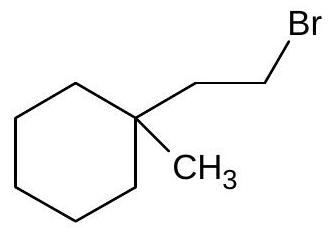
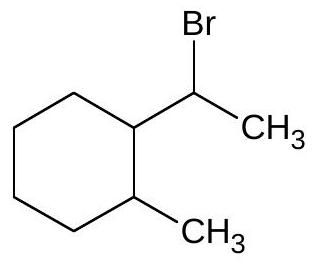
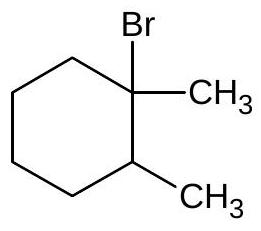
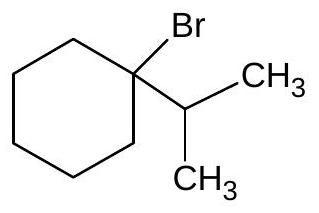
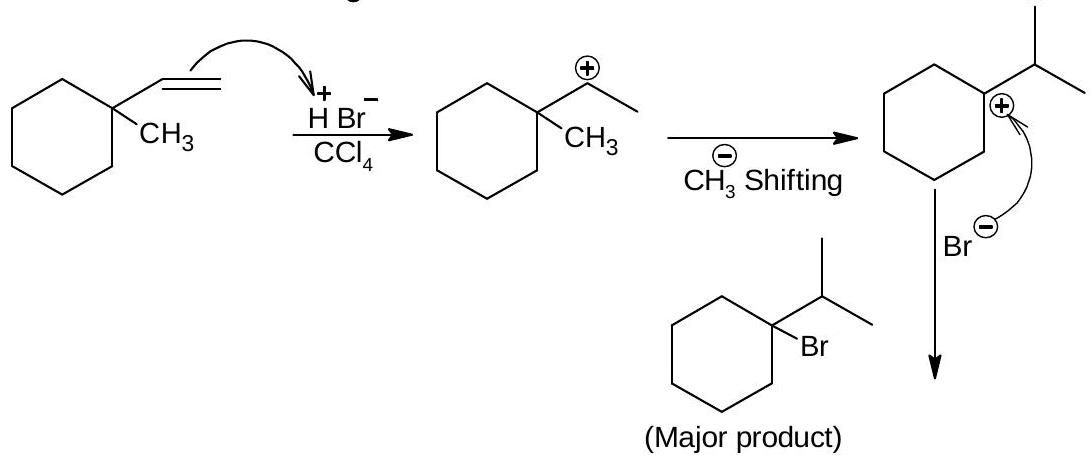
Hydrogen bromide in carbon tetrachloride adds across the vinyl group by the ionic Markovnikov route. The proton goes to the terminal CH2, which leaves a secondary carbocation on the side-chain carbon attached to the quaternary ring carbon. A methyl group migrates with its bonding pair from that ring carbon to the cationic centre; the charge passes to the ring carbon, which is now tertiary, and the side chain becomes an isopropyl group. Bromide then captures this tertiary cation, so the major product is 1-bromo-1-isopropylcyclohexane, the cyclohexane ring carrying bromine and an isopropyl group on the same carbon.
JEE Main · 2021 · 17 Mar 2021 · Shift 1 · Single correct option