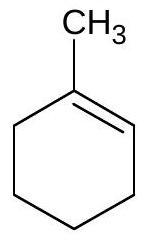
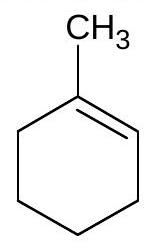
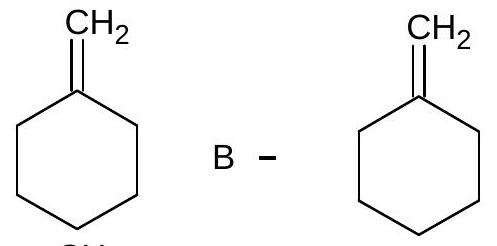
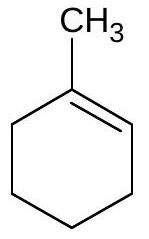
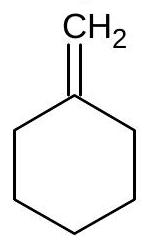
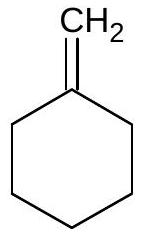
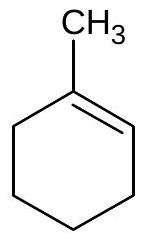
The products "A" and "B" formed in above reactions are:
(A)(see structures)AB
(B)(see structure)A
(C)(see structures)AB✓ Correct
(D)(see structures)AB
Answer: (C)
Solution
Dilute phosphoric acid at 358 K protonates the hydroxyl group of 1-methylcyclohexan-1-ol and water leaves, giving a tertiary carbocation. The cation then loses a proton, and in this E1 route the proton comes from a ring carbon rather than from the methyl group, since that gives the trisubstituted endocyclic alkene in place of the disubstituted exocyclic one. The Saytzeff product is obtained, so A is 1-methylcyclohexene. Potassium tert-butoxide acting on 1-chloro-1-methylcyclohexane is a one-step E2 elimination, and the base is bulky. Its approach to the crowded ring hydrogens is hindered, so it abstracts the exposed hydrogen of the methyl group and the Hofmann product is obtained. B is methylenecyclohexane.
JEE Main · 2021 · 16 Mar 2021 · Shift 1 · Single correct option