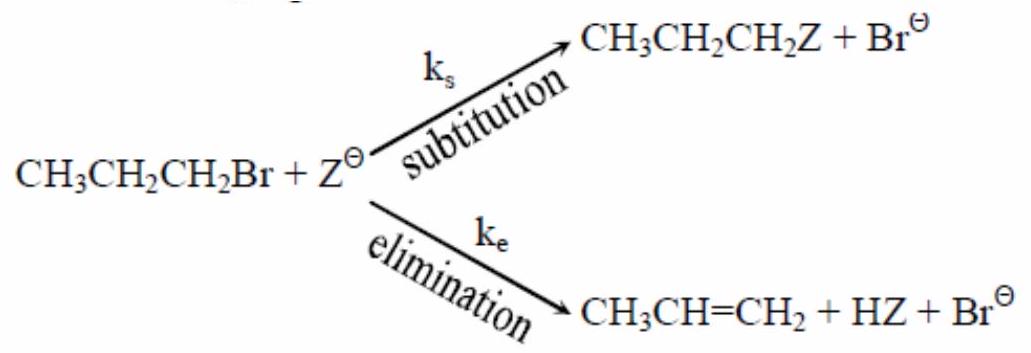
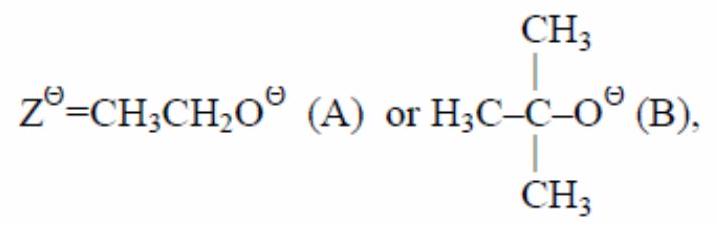
ks and ke are respectively, the rate constant for substitution and elimination, and μ=keks, the correct option is ____
(A)μB>μA and ke(A)>ke(B)
(B)μA>μB and ke(A)>ke(B)
(C)μA>μB and ke(B)>ke(A)✓ Correct
(D)μB>μA and ke(B)>ke(A)
Answer: (C)
Solution
The base here is bulky tert-butoxide, which pushes the reaction toward elimination rather than substitution. The more hindered substrate leans even harder on elimination, so its elimination rate constant is the larger, ke(B)>ke(A). Since μ=keks, a bigger elimination rate means a smaller μ, so μA>μB. Putting the two together, μA>μB while ke(B)>ke(A).
JEE Main · 2020 · 07 Jan 2020 · Shift 2 · Single correct option