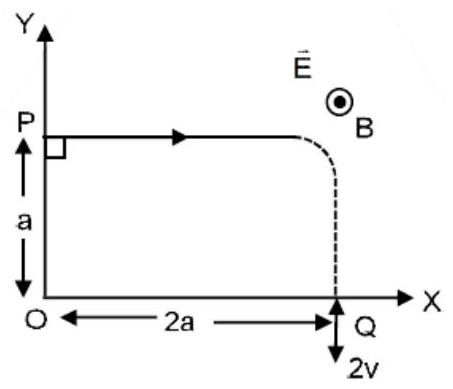
A charged particle of mass 'm' and charge 'q' moving under the influence of uniform electric field Ei and a uniform magnetic field Bk follows a trajectory from point P to Q as shown in figure. The velocities at P and Q are respectively, vi and −2vj. Then which of the following statements (A,B,C,D) are the correct? (Trajectory shown is schematic and not to scale) (a) E=43(qamv2) (b) Rate of work done by the electric field at P is 43(amv3) (c) Rate of work done by both the fields at Q is zero. (d) The difference between the magnitude of angular momentum of the particle at P and Q is 2 mav.
(A)(b), (c), (d)
(B)(a), (b), (c)✓ Correct
(C)(a), (c), (d)
(D)(a), (b), (c), (d)
Answer: (B)
Solution
Between P and Q only the electric field does work, since the magnetic force always stays perpendicular to the velocity. That work, qE(2a), equals the change in kinetic energy 21m(2v)2−21mv2=23mv2, giving E=4qa3mv2, so statement (a) holds. The instantaneous power delivered at P is qEv=4a3mv3, confirming statement (b). At Q the velocity −2vj^ is perpendicular to Ei^, so the electric field does no work there and the magnetic field never does, which makes statement (c) correct. For the angular momentum, at P the position ai^ is parallel to the velocity vi^ so LP=0, whereas at Q, LQ=m(−2vj^)×(2ai^)=4mvak^; the difference in magnitudes is 4mva, not 2mva, so statement (d) fails. The correct statements are (a), (b) and (c).
JEE Main · 2020 · 09 Jan 2020 · Shift 1 · Single correct option