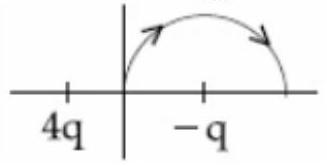
A two point charges 4q and −q are fixed on the x-axis at x=−2d and x=2d, respectively. If a third point charge ' q ' is taken from the origin to x=d along the semicircle as shown in the figure, the energy of the charge will:
(A)decrease by 3πϵ0d4q2✓ Correct
(B)increase by 3πϵ0d2q2
(C)increase by 4πϵ0d3q2
(D)decrease by 4πϵ0dq2
Answer: (A)
Solution
Because electrostatic potential energy depends only on the end points and not on the semicircular path, we only need the energy of the moving charge q with the two fixed charges at the start and at the finish. At the origin the charge is a distance d/2 from both 4q and −q, so Ui=d/2k(4q)(q)+d/2k(−q)(q)=d8kq2−d2kq2=d6kq2. At the final point x=d it is a distance 3d/2 from 4q and d/2 from −q, giving Uf=3d/2k(4q)(q)+d/2k(−q)(q)=3d8kq2−d2kq2=3d2kq2. The change is ΔU=Uf−Ui=3d2kq2−d6kq2=−3d16kq2, and with k=4πϵ01 this is −3πϵ0d4q2. The negative sign means the energy of the charge decreases by 3πϵ0d4q2.
JEE Main · 2020 · 04 Sep 2020 · Shift 1 · Single correct option