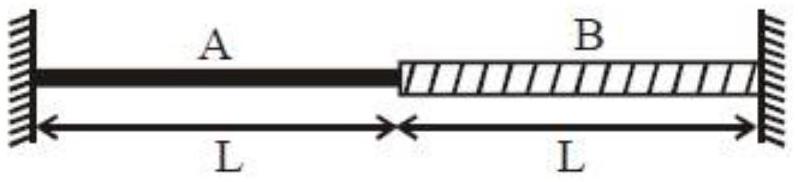
A wire of length 2 L is made by joining two wires A and b of same lengths but different radii r and 2r and made of the same material. It is vibrating at a frequency such that the joint of the two wires forms a node. If the number of antinodes in wire A is p and that in B is q then the ratio p:q is:
(A)1:4
(B)1:2✓ Correct
(C)3:5
(D)4:9
Answer: (B)
Solution
Both wires are of the same material and length L and carry the same tension, so they differ only in linear mass density, which scales as the square of the radius: wire B has twice the radius of A, so μB=4μA. The wave speed v=T/μ then makes vB=21vA. With a node forced at the joint, each wire holds a whole number of loops at the common frequency f=2LpvA=2LqvB. Cancelling gives pvA=qvB=q2vA, so p:q=1:2. The antinode count equals the loop count, so the ratio of antinodes is 1:2.
JEE Main · 2019 · 08 Apr 2019 · Shift 1 · Single correct option