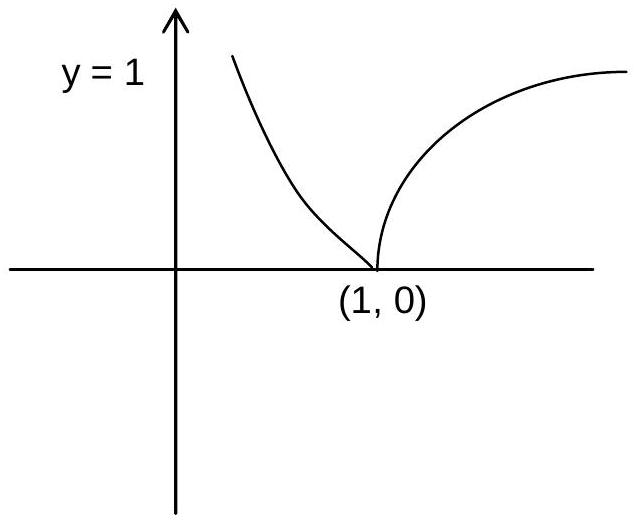
Let a function f:(0,∞)→(0,∞) be defined by f(x)=1−x1. Then f is:
(A)not injective but it is surjective
(B)injective only
(C)neither injective nor surjective✓ Correct
(D)both injective as well as surjective
Answer: (C)
Solution
Write f(x)=1−x1, which is 1−x1 for x>1 and x1−1 for 0<x<1. It is not one-one: f(2)=21 and f(32)=23−1=21, yet 2=32. It is not onto either: f(1)=0 and f(x)>0 elsewhere, so the range is [0,∞), which does not fill the codomain (0,∞). Hence f is neither injective nor surjective.
JEE Main · 2019 · 11 Jan 2019 · Shift 2 · Single correct option