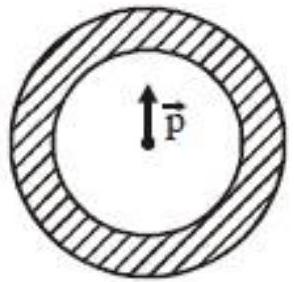
Shown in the figure is a shell made of a conductor. It has inner radius a and outer radius b, and carries charge Q. At its centre is a dipole P as shown. In this case :
(A)Surface charge density on the inner surface of the shell is zero everywhere.
(B)Electric field outside the shell is the same as that of a point charge at the centre of the shell.✓ Correct
(C)Surface charge density on the inner surface is uniform and equal to 4πa2(Q/2)
(D)Surface charge density on the outer surface depends on ∣P∣
Answer: (B)
Solution
A dipole carries zero net charge, so by Gauss's law the charge induced on the inner surface of the conducting shell sums to zero, though it is distributed non-uniformly to match the dipole field. Inside the metal the field is zero, which isolates the outside from the details of that inner distribution: all of the shell's own charge Q spreads uniformly over the outer surface. Consequently, for any point outside the shell the field is exactly that of a single point charge Q placed at the centre, E=r2kQ, independent of the dipole moment.
JEE Main · 2019 · 12 Apr 2019 · Shift 1 · Single correct option