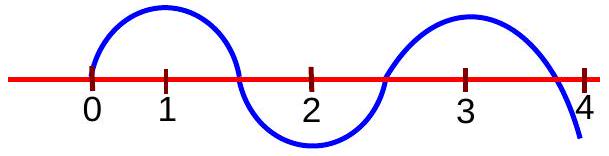
Let f:R→R be a thrice differentiable function such that f(0)=0,f(1)=1,f(2)=−1,f(3)=2 and f(4)=−2. Then, the minimum number of zeros of (3f′f′′+ff′′′)(x) is ____.
Answer: 5
Solution
Note the identity dx2d2(ff′)=(f′2+ff′′)′=3f′f′′+ff′′′, so the expression is (ff′)′′.
f(0)=0,f(1)=1,f(2)=−1,f(3)=2,f(4)=−2: consecutive sign changes (at x=0 itself and between 1&2, 2&3, 3&4) force at least 4 zeros of f by IVT (continuity).
Between each pair of consecutive zeros of f, Rolle's theorem gives a zero of f′: at least 3 zeros of f′.
k=ff′ vanishes at every zero of f (4) and every zero of f′ (3), all distinct in the generic case: at least 7 zeros of k.
Applying Rolle's theorem to k between consecutive zeros: k′ has at least 6 zeros; applying Rolle's theorem again to k′: k′′=(ff′)′′=3f′f′′+ff′′′ has at least 5 zeros.