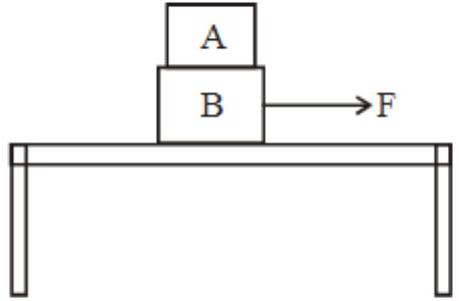
Two blocks A and B of masses mA=1kg and mB=3kg are kept on the table as shown in figure. The coefficient of friction between A and B is 0.2 and between B and the surface of the table is also 0.2. The maximum force F that can be applied on B horizontal, so that the block A does not slide over the block B is: [Take g=10m/s2]
(A)8 N
(B)16 N✓ Correct
(C)12 N
(D)40 N
Answer: (B)
Solution
Block A rides on B only as long as friction can supply its acceleration. The most friction A can feel is f=μmAg=0.2×1×10=2N, which caps the shared acceleration at a=mAf=2m s−2. Treating A and B as one body of mass 4kg, the table drags back with μ(mA+mB)g=0.2×4×10=8N, so Newton's second law reads F−8=4×2, giving F=16N as the largest force that keeps them moving together.
JEE Main · 2019 · 10 Apr 2019 · Shift 2 · Single correct option