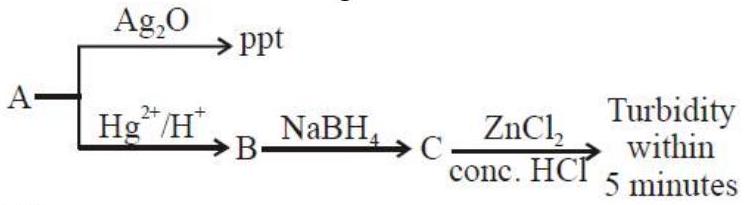
The clue chain pins down A one step at a time. First, A gives a precipitate with Ag2O (ammoniacal silver): only a terminal alkyne, with its acidic ≡C−H, forms an insoluble silver acetylide, so A has to be a terminal alkyne. Next, A undergoes Hg2+/H+ hydration (Markovnikov) to the carbonyl B, which NaBH4 then reduces to the alcohol C. Finally C is treated with ZnCl2/conc. HCl, the Lucas reagent: turbidity appearing within about five minutes is the signature of a secondary alcohol. For C to be secondary, its precursor B must be a ketone, i.e. the hydration of A delivered the oxygen onto an internal carbon. Acetylene, CH≡CH, would hydrate to acetaldehyde and finish as ethanol, a primary alcohol that gives no quick Lucas turbidity; but-2-yne is internal and would give no silver-acetylide precipitate at all. Propyne, CH3−C≡CH, hydrates to acetone, which NaBH4 reduces to propan-2-ol — a secondary alcohol that turns the Lucas reagent turbid in a few minutes — and its terminal ≡C−H accounts for the Ag2O precipitate. Hence A is CH3−C≡CH.
JEE Main · 2019 · 12 Apr 2019 · Shift 2 · Single correct option