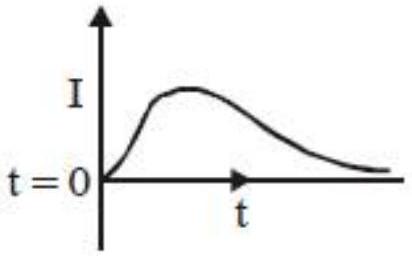
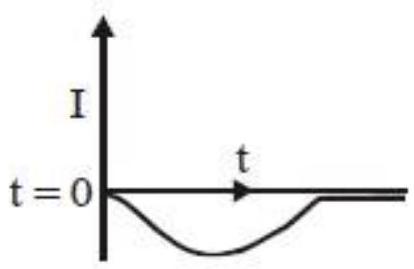
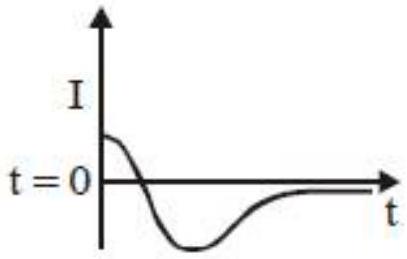
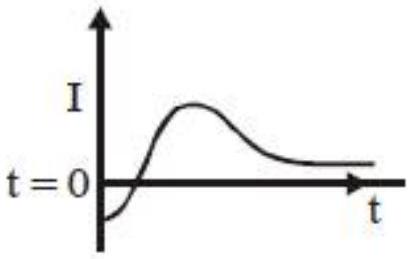
A very long solenoid of radius R is carrying current I(t)=kte−αt(k>0), as a function of time ( t≥0 ). counter clockwise current is taken to be positive. A circular conducting coil of radius 2 R is placed in the equatorial plane of the solenoid and concentric with the solenoid. The current induced in the outer coil is correctly depicted, as a function of time, by:-
(A)(see structure)
(B)(see structure)
(C)(see structure)
(D)(see structure)✓ Correct
Answer: (D)
Solution
The field inside the solenoid is proportional to I(t)=kte−αt, so the flux the outer coil links follows the same shape, and the induced current is proportional to −dtdI. Differentiating, dtdI=ke−αt(1−αt), which is positive before t=α1 and negative after it. The induced current therefore starts with one sign at t=0, falls to zero exactly at t=α1 where dtdI changes sign, reverses, and then decays back to zero as t→∞. The graph showing this single sign reversal, with a zero-crossing at t=α1 and a decay to zero, is the one that fits.
JEE Main · 2019 · 09 Apr 2019 · Shift 2 · Single correct option