JEE Main · 2019 · 10 Apr 2019 · Shift 1 · Haloalkanes and Haloarenes

WhatsApp Email
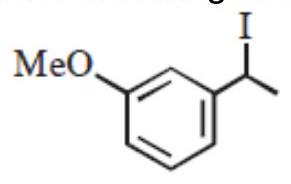
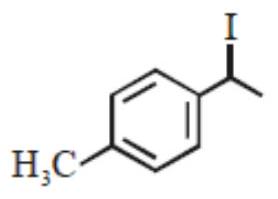
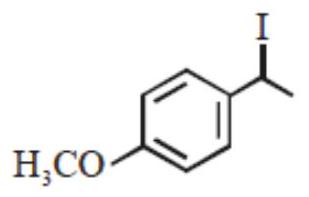
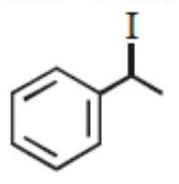
Increasing rate of reaction in the following compounds is
  1. (A)(A) < (B) < (C) < (D)
    Structure A
    A
    Structure B
    B
    Structure C
    C
  2. (B)(A) < (B) < (D) < (C)
  3. (C)(B) < (A) < (D) < (C)
  4. (D)(B) < (A) < (C) < (D)✓ Correct

Answer: (D)

Solution

The rate of an reaction is controlled by the stability of the benzylic carbocation that forms. A para-methoxy group feeds its oxygen lone pair by resonance straight onto the benzylic centre, giving the most stabilised cation and hence the fastest reaction, whereas a para-methyl group stabilises only weakly through hyperconjugation. A meta-methoxy group cannot donate by resonance to the cationic carbon and instead pulls electron density away inductively, so that compound reacts slowest. The rate therefore increases as meta-methoxy < unsubstituted < para-methyl < para-methoxy.

JEE Main · 2019 · 10 Apr 2019 · Shift 1 · Single correct option
More JEE Main questions on Haloalkanes and Haloarenes

  1. The correct order of reactivity of in methanol with the following nucleophiles is and
    JEE Main 2026View solution →
  2. The correct order of the rate of reaction of the following reactants with nucleophile by mechanism is :
    (Given : Structure I and II are rigid)
    JEE Main 2026View solution →
  3. The correct order of reactivity of the following benzyl halides towards reaction with KCN is:
    JEE Main 2026View solution →
  4. The correct order of the rate of the reaction for the following reaction with respect to nucleophiles is:
    JEE Main 2026View solution →
  5. Given below are four compounds:
    (a) n-propyl chloride
    (b) iso-propyl chloride
    (c) sec-butyl chloride
    (d) neo-pentyl chloride

    Percentage of carbon in the one which exhibits optical isomerism is:
    JEE Main 2026View solution →
  6. Consider the following reaction :


    The product Y formed is :
    JEE Main 2026View solution →