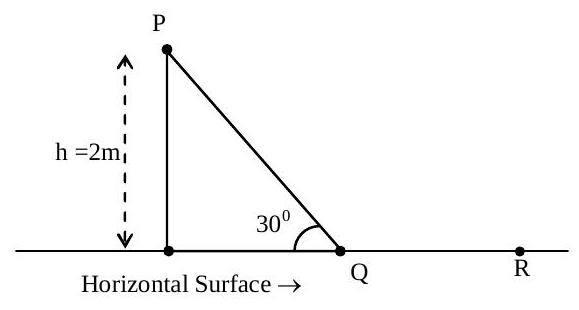
A point particle of mass m, moves along the uniformly rough track PQR as shown in the figure. The coefficient of friction, between the particle and the rough track equals μ. The particle is released, from rest, from the point P and it comes to rest at a point R. The energies, lost by the ball, over the parts, PQ and QR, of the track, are equal to each other, and no energy is lost when particle changes direction from PQ to QR.
The values of the coefficient of friction μ and the distance x(=QR), are, respectively close to :
(A)0.2 and 3.5 m
(B)0.29 and 3.5 m✓ Correct
(C)0.29 and 6.5 m
(D)0.2 and 6.5 m
Answer: (B)
Solution
Since the particle starts and ends at rest, the friction loss on PQ equals the loss on QR. With the incline at 30∘ and PQ =4 m, μmgcos30∘×4=μmgx, so x=4cos30∘=23≈3.5 m. Applying the work-energy theorem over the whole path P to R, where the kinetic energy change is zero, the fall supplies mgsin30∘×4 while friction removes μmgcos30∘×4 on PQ and μmgx on QR: mg×2=μmg×23+μmg×23, so 2=43μ and μ=231≈0.29.
JEE Main · 2016 · 03 Apr 2016 · Offline · Single correct option