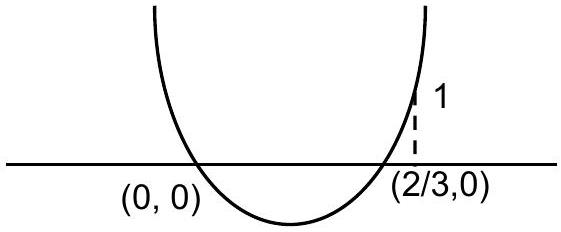
If a∈R and the equation −3(x−[x])2+2(x−[x])+a2=0 (where [x] denotes the greatest integer ≤x) has no integral solution, then all possible values of a lie in the interval
(A)(−1,0)∪(0,1)✓ Correct
(B)(1,2)
(C)(−2,−1)
(D)(−∞,−2)∪(2,∞)
Answer: (A)
Solution
Let t=x−[x] be the fractional part, so 0≤t<1, and the equation becomes a2=3t2−2t. Asking for no integral solution means x is not an integer, so t runs over 0<t<1. On this range f(t)=3t2−2t dips to its least value −31 at t=31 and climbs towards f(1)=1, while f(0)=0. Since a2≥0, a fractional solution exists only for 0≤a2<1, and discarding a=0 leaves a∈(−1,0)∪(0,1).
JEE Main · 2014 · 06 Apr 2014 · Offline · Single correct option