JEE Main · 2013 · 07 Apr 2013 · Offline · Modern Physics

WhatsApp Email
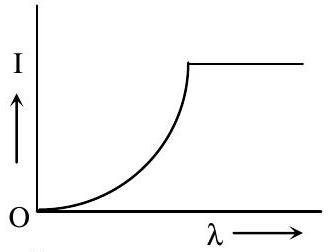
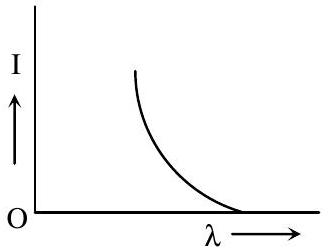
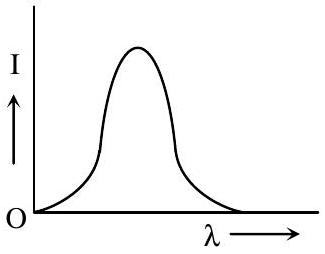
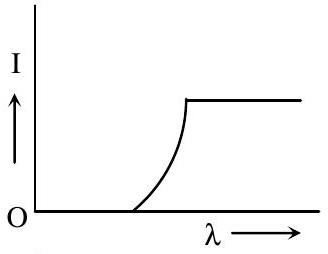
The anode voltage of a photocell is kept fixed. The wavelength of the light falling on the cathode is gradually changed. The plate current I of the photocell varies as follows:
  1. (A)(see structure)
  2. (B)(see structure)
  3. (C)(see structure)
    ✓ Correct
  4. (D)(see structure)

Answer: (C)

Solution

A photocell passes current only when the incident photons carry enough energy to eject electrons, which means the wavelength must stay shorter than the threshold . For every emission occurs and, with the collecting voltage held fixed, the current sits at its steady saturation value; the instant climbs past the photons are too feeble and the current drops to zero. The matching graph is the one that holds a constant current up to and then falls sharply to nothing.

JEE Main · 2013 · 07 Apr 2013 · Offline · Single correct option
More JEE Main questions on Modern Physics

  1. 7.9 MeV α-particle scatters from a target material of atomic number 79. From the given data the estimated diameter of nuclei of the target material is (approximately) ______ m.
    [ Nm²/C² and electron charge C]
    JEE Main 2026View solution →
  2. The minimum frequency of photon required to break a particle of mass 15.348 amu into particles is ______ kHz.
    [mass of He nucleus = 4.002 amu, amu kg, J.s and m/s]
    JEE Main 2026View solution →
  3. The smallest wavelength of Lyman series is 91 nm. The difference between the largest wavelengths of Paschen and Balmer series is nearly nm.
    JEE Main 2026View solution →
  4. Light is incident on a metallic plate having work function . If the produced photoelectrons have zero kinetic energy then the angular frequency of the incident light is ______ . ( …
    JEE Main 2026View solution →
  5. The energy of an electron in an orbit of the Bohr's atom is where is the ground state energy. If L is the angular momentum of the electron in this orbit and h is the Planck's constant, then …
    JEE Main 2026View solution →
  6. A particle having electric charge and mass is accelerated by applying an electric potential of 1.21 V . Wavelength of the matter wave associated with the particle is . The va …
    JEE Main 2026View solution →